Best Under-Counter Wine Fridges for a 24-Inch (or 15-Inch) Opening
An under-counter wine fridge has to fit the gap, breathe out the front and keep reds and whites at different temperatures. Our picks for the best built-in wine fridges, compared on maker spec sheets.

We may earn a commission if you buy through links on this page. It never changes what we recommend. As an Amazon Associate we earn from qualifying purchases. Learn more.
Our top picks at a glance
- Check Amazon Price
A front-venting 24-inch dual zone with a key lock, temperature memory after power cuts and wooden shelves with bottle stoppers. Read more
Pros
- Front vent for built-in use
- Remembers settings after a power cut
- Under 40 dB listed
Cons
- Upper zone stops at 50°F
- Tall bottles cut the 46-bottle count
- Check Amazon Price
The most bottles of our 24-inch picks, with 34 in the lower zone and a 3-year compressor warranty. Read more
Pros
- 52 bottles (18 upper and 34 lower)
- 3-year compressor warranty
- Sapele wood shelves
Cons
- Needs the full 24 x 34 inch opening
- 41 dB is the loudest listed here
- Check Amazon Price
A long-running 24-inch built-in with a 39 dB rating, a lock and a 40 to 55°F upper zone for whites. Read more
Pros
- 39 dB rating
- Lock and recessed kickplate
- 2-year warranty on Newair's site
Cons
- Same 46-bottle limit as the Kalamera
- Shelf count not listed
- Check Amazon Price
Two zones in a 14.8-inch-wide cabinet, for the narrow gap at the end of a run of cabinets. Read more
Pros
- Fits a 15-inch opening
- Two zones in a narrow body
- Lock and carbon filter
Cons
- Noise level not listed
- Holds about 29 standard bottles
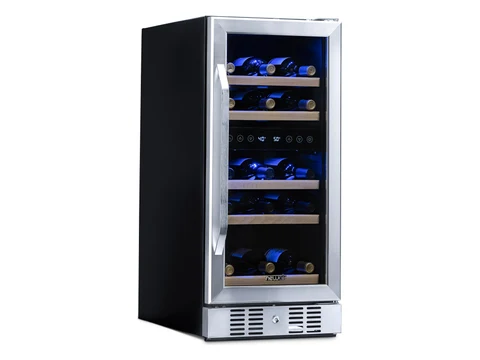
An under-counter wine fridge looks like a simple buy until you try to slide one into the cabinet gap. Three things matter more than the bottle count on the box: it has to breathe out the front, it has to actually fit the opening, and for most wine drinkers it needs two zones, so whites can sit colder than reds.
We built this list around those three, using the makers’ own spec sheets and manuals. Every pick below is front-venting, sold as built-in or freestanding, and has dual temperature zones.
Side by side
| Wine fridge | Width | Height | Bottles | Upper zone | Lower zone | Listed noise |
|---|---|---|---|---|---|---|
| Kalamera 24” 46-Bottle | 23.4” | 33” | 46 | 40–50°F | 50–66°F | Under 40 dB |
| Ca’Lefort 24” 52-Bottle | 23.8” | 33.8” | 52 (18 + 34) | 40–65°F (set colder than lower) | 40–65°F | 41 dB |
| Newair 46-Bottle Built-In | 23.4” | 33” | 46 | 40–55°F | 50–66°F | 39 dB |
| Newair 29-Bottle 15-Inch | 14.8” | 33.75” | 29 | 40–55°F | 50–66°F | Not listed |
Sizes, zone ranges and noise ratings are from Kalamera, Ca'Lefort and Newair product pages and manuals, checked November 2026. Bottle counts assume standard 750 ml Bordeaux bottles. Prices change often, so check current listings.
How we picked
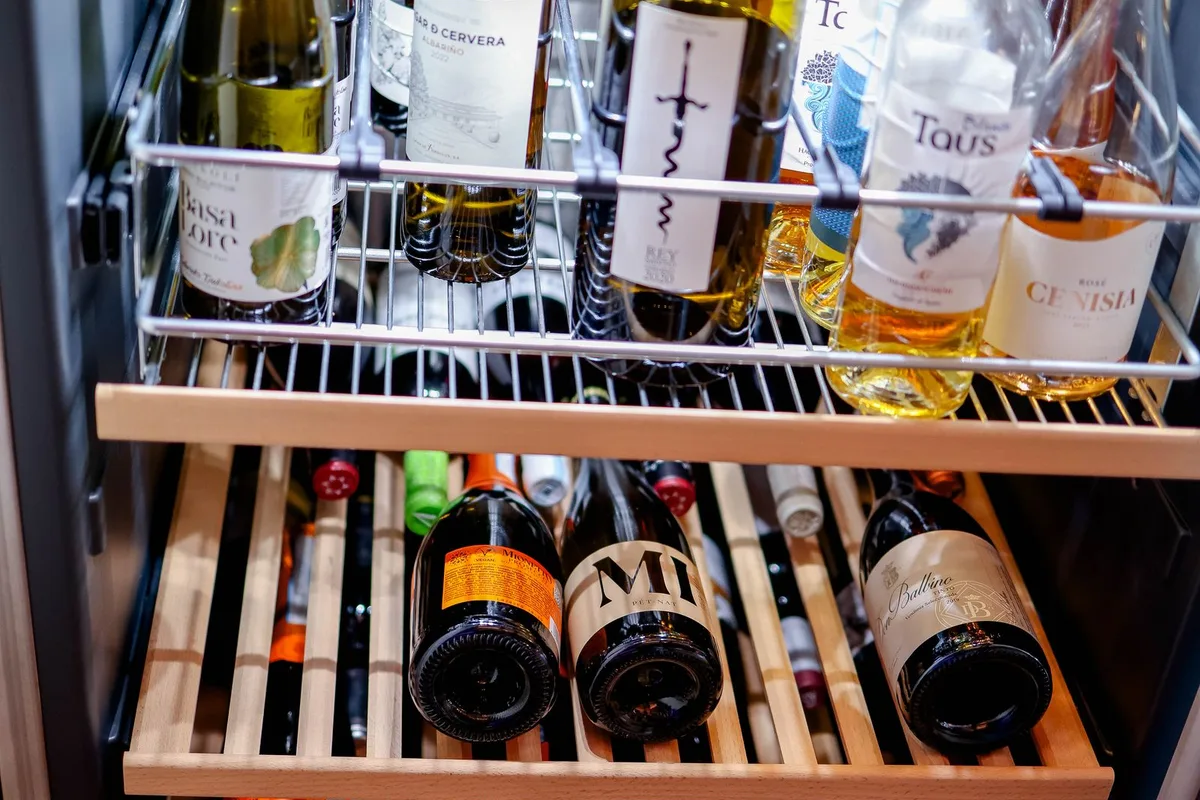
We started with the wine fridges that show up again and again for under-counter installs, then threw out anything that failed the basics:
- Front venting. A rear-vented fridge pushed into a cabinet has nowhere to dump its heat. Every pick here vents through the grille at the bottom front.
- A real fit for a standard opening. That means about 24 inches wide (or 15 for the narrow models) and under about 34 inches tall, so it slides under a standard 36-inch counter.
- Two zones with ranges that actually cover white and red storage.
- Compressor cooling. Thermoelectric coolers struggle in a warm kitchen and aren’t meant to be boxed in.
We haven’t tested these wine fridges ourselves. Read more about how we pick products.
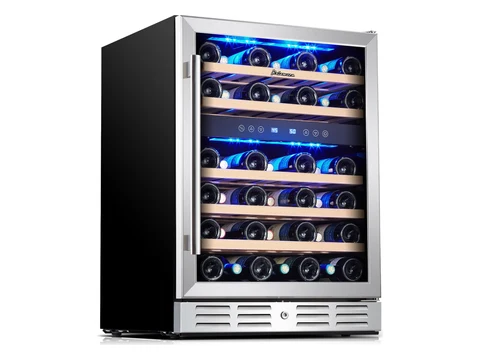
1. Kalamera 24-Inch 46-Bottle Dual Zone Wine Cooler: Best overall
Good fit for: Most kitchens with a standard 24-inch gap and a mixed collection of reds and whites.
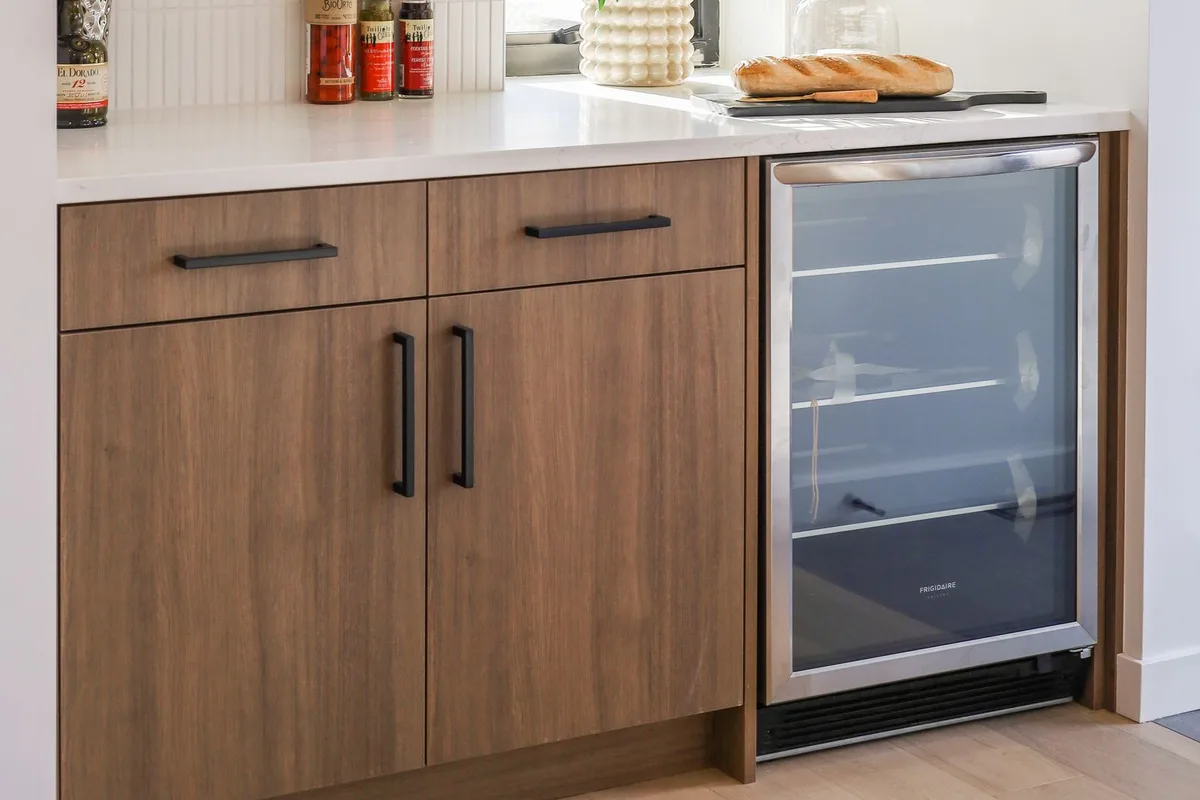
Kalamera’s 24-inch dual zone has the features that matter for a built-in and very little fluff. The cabinet is 23.4 inches wide, 33 inches tall and 22.4 inches deep, so it has room to spare in a standard 24-inch opening under a 36-inch counter. It vents out the front, and Kalamera sells it for both built-in and freestanding use.
The upper zone runs 40 to 50°F for whites and sparkling, and the lower zone runs 50 to 66°F for reds. There’s a temperature memory function, so after a power cut it goes back to your settings instead of a factory default. The five wooden shelves pull out and have stoppers on each side so bottles don’t roll off the front. You also get a key lock, automatic defrost, a reversible door and a noise rating Kalamera lists as under 40 dB.
What bugs us: The upper zone tops out at 50°F, so you can’t run both zones warm for long-term red storage. The 46-bottle count assumes standard Bordeaux bottles. Kalamera notes that bigger bottles, such as Pinot or Champagne, take more room.
Skip it if: you want the most bottles you can fit in 24 inches. The Ca’Lefort holds 52.
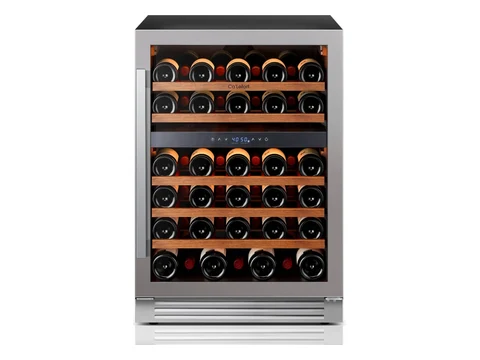
2. Ca’Lefort 24-Inch 52-Bottle Dual Zone Wine Fridge: Most bottles
Good fit for: Collectors who want to squeeze the most bottles into a single 24-inch gap.
Ca’Lefort rates this 24-inch model at 52 standard bottles: 18 in the upper zone and 34 in the lower. That’s six more than the Kalamera and Newair. The shelves are Sapele wood, the door is double-pane glass with UV protection, and the lights can be set to one of three colors. It vents out the front.
It also has the clearest warranty of the 24-inch picks: Ca’Lefort lists 1 year on the whole unit, 2 years on parts and 3 years on the compressor.
What bugs us: It’s the biggest cabinet here at 23.8 inches wide and 33.8 inches tall. Ca’Lefort’s recommended cutout is 24.05 by 34.05 inches, so measure your opening first. Both zones share one 40 to 65°F range, and the manual says the upper zone must always be set colder than the lower zone. At 41 dB, it has the highest noise rating on our list.
Skip it if: your opening is a hair under 24 inches wide or 34 inches tall.
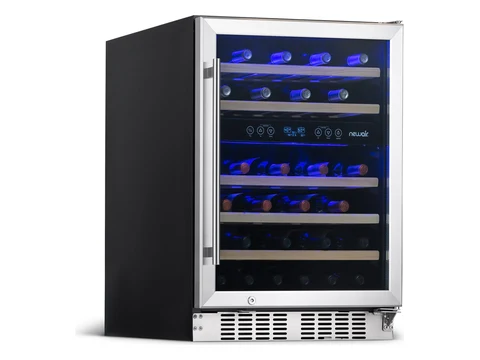
3. Newair 46-Bottle Built-In Dual Zone Wine Fridge: Quietest listed
Good fit for: Open-plan kitchens and home bars, where a humming fridge would get on your nerves.
Newair’s 46-bottle built-in (model AWR-460DB, also sold as NWC046SS01) has been around for years, and it has the lowest noise rating of our picks at 39 dB. Its cabinet size matches the Kalamera’s: 23.4 inches wide, 33 inches tall and 22.4 inches deep, or 24 inches deep counting the handle.
The upper zone goes a little warmer than the Kalamera’s, 40 to 55°F, which gives you more room for whites you like served less icy. The lower zone runs 50 to 66°F. It has removable beechwood shelves, a double-pane UV-protected glass door, a lock and a recessed kickplate. Newair’s own site lists a 2-year warranty.
What bugs us: It has the same 46-bottle limit as the Kalamera, so you’re choosing on noise and warranty, not space. Newair doesn’t list a shelf count. And because the Amazon listing gives a 1-year warranty while Newair’s site says 2, keep your receipt and check with Newair after you buy.
Skip it if: you need more than 46 bottles. Go with the Ca’Lefort.
4. Newair 29-Bottle 15-Inch Built-In Dual Zone Wine Fridge: Best 15-inch
Good fit for: The narrow 15-inch spot at the end of a cabinet run or beside a dishwasher.
A lot of kitchens don’t have a spare 24-inch base cabinet, but they do have a 15-inch filler or drawer stack. This Newair (AWR-290DB) is 14.8 inches wide, 33.75 inches tall and 22.6 inches deep, and it still gives you two zones: 40 to 55°F up top and 50 to 66°F below. It vents out the front, has five removable beechwood shelves, a lock, a carbon filter and triple-tempered, UV-resistant door glass. Newair lists a 2-year warranty.
What bugs us: Newair doesn’t publish a noise rating for this model. At 33.75 inches tall, it leaves very little headroom under a 34-inch opening, so check yours with a tape measure. It holds about 29 standard bottles, so it’s a rack for what you’re drinking soon, not a cellar.
Skip it if: you have room for a 24-inch model. You’ll get more than half again as many bottles.
How to choose an under-counter wine fridge
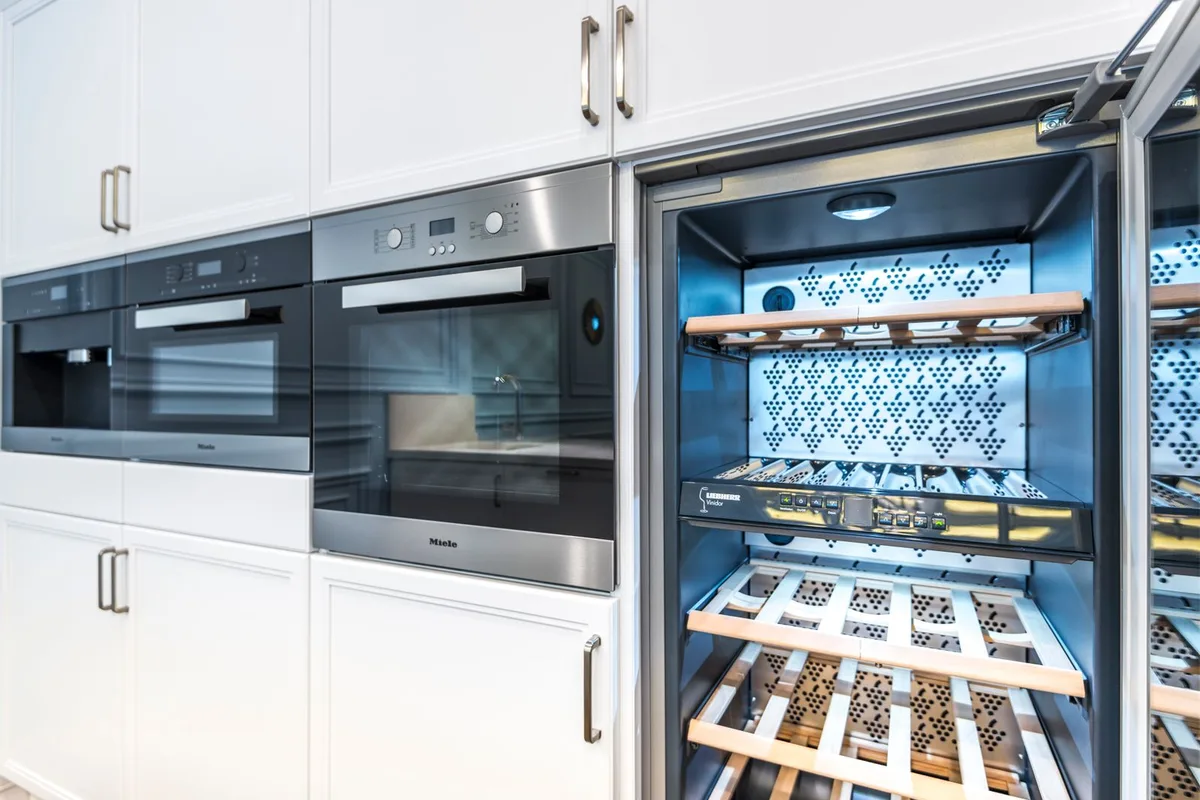
Front venting is not optional
This is the easiest mistake to make. A freestanding-only wine fridge pushes heat out the back or sides. Box it into a cabinet and it runs constantly, gets louder and can fail early. If you’re building it in, the spec sheet has to say front venting or built-in. Keep the bottom front grille clear, so no toe-kick panel or rug in front of it.
Measure the opening, not the old appliance
Measure the width at the front and the back of the gap, and the height from the floor to the underside of the counter. Then compare against the maker’s cutout dimensions, not the cabinet size. A standard base cabinet opening is about 24 inches wide, and under a 36-inch counter you usually have about 34 to 34.5 inches of height. Leave room for the power cord and the plug behind the unit, and check that the door can swing past the handles of the cabinets next to it.
Dual zone or single zone?
Dual zone makes sense if you drink both whites and reds and want them ready to pour. Set the upper zone for whites and sparkling (roughly the mid-40s to about 50°F) and the lower zone for reds (the upper 50s to mid-60s). If you’re storing wine for the long haul instead of serving it, both colors age well at about 55°F. A single-zone model at 55°F works just as well for that.
Bottle counts are optimistic
Every rated capacity assumes slim 750 ml Bordeaux bottles laid in a tight pattern. Burgundy, Pinot Noir and Champagne bottles are fatter and take more room. Plan on fitting about 15 to 25 percent fewer bottles if your collection is mostly those shapes.
Wine fridge or beverage fridge?
A wine fridge usually bottoms out around 40°F, which isn’t cold enough for beer or soda. If you mostly want cold cans, look for a beverage fridge or a combo wine and beverage unit instead. For a general mini fridge with a real freezer, see the best mini fridges with a freezer.
Quick answers
Can I put a freestanding wine fridge under the counter? Only if the maker says it’s built-in or front-venting. Rear-vented models need open air around them.
How much power does a wine fridge use? Less than a full-size fridge. Newair lists 90 watts for both of its picks here, and the compressor cycles on and off rather than running constantly. For context, here’s how many watts refrigerators use.
Can a wine fridge go in the garage? Most are rated for indoor use only, and a hot or freezing garage can push them past what they can handle. Check the manual’s room temperature range first, or look at the best garage refrigerators.
Is a wine fridge loud? The ones here are rated at 39 to 41 dB, about as loud as a quiet library. You’ll hear the compressor kick on in a silent room, but not over normal kitchen noise.