Best Infrared Heaters for Large Rooms (and What "Up to 1,000 Sq Ft" Really Means)
Four infrared space heaters that make sense for a big living room, basement or open floor plan, plus the honest math on how much room one plug-in heater can actually warm.


Our top picks at a glance
- Check Amazon Price
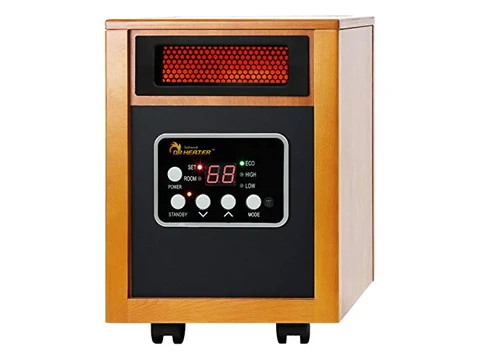
The quiet wood-cabinet heater that made this category popular. A quartz infrared element plus a PTC element, a real thermostat, a remote and a washable filter. Read more
Pros
- Dual quartz and PTC heating
- Thermostat with High, Low and Eco modes
- Quiet blower
- Washable filter
- Rolls on casters
Cons
- Still 1500 watts like every plug-in heater
- Plain looks
- Check Amazon Price
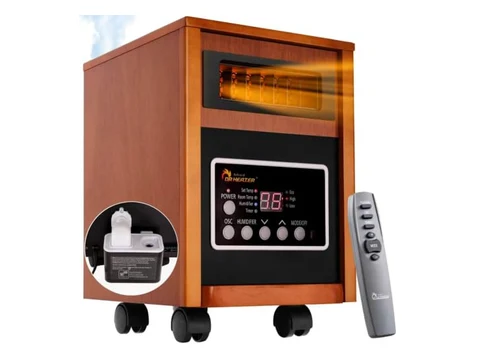
The DR-968's bigger sibling, with oscillation to spread warm air around a wide room and a small built-in humidifier for the dry air that forced heat brings. Read more
Pros
- Oscillation spreads heat across the room
- Built-in cool-mist humidifier
- Thermostat from 50 to 85°F
- 12-hour timer and remote
Cons
- Humidifier is small and needs refilling
- Bigger cabinet than the DR-968
- Check Amazon Price
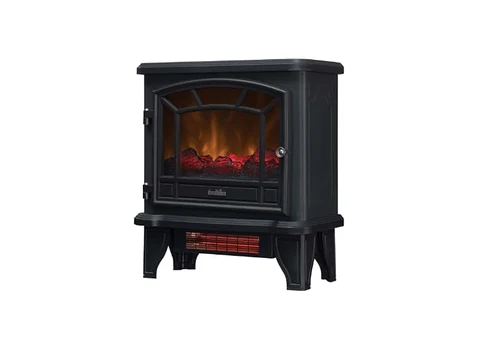
A cast-iron-style stove with a flickering flame effect and an infrared quartz heater inside. Nice in a family room where you want the look of a wood stove without the wood. Read more
Pros
- Flame effect runs with or without heat
- Remote and adjustable thermostat
- Looks like furniture instead of an appliance
Cons
- Same 1500 watts as the plain boxes
- Flame effect is the main reason to pay more
- Check Amazon Price
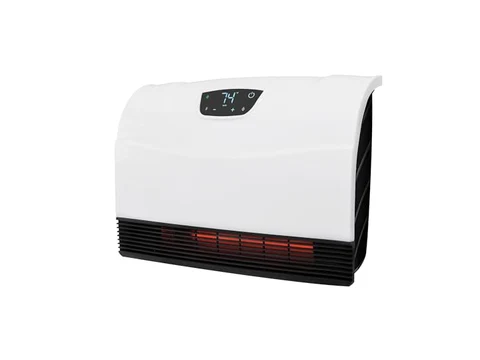
A slim 1500-watt quartz infrared heater that screws to the wall, out of the way of kids, pets and vacuum cords, with a phone app for schedules. Read more
Pros
- Mounts on the wall and frees up floor space
- Wi-Fi app with schedules
- Thermostat on the unit, the remote and the app
- Only about 8.5 pounds
Cons
- Has to be wall-mounted
- 1-year warranty
Every infrared heater box seems to promise a giant room. “Heats up to 1,000 square feet.” “Large room heater.” Then you plug one into a cold, open living room and it barely takes the chill off. The heater isn’t broken. The box is just doing some optimistic math.
Here’s the honest version, then four infrared heaters that are worth it for a big room, as long as you use them the right way.
The math nobody puts on the box
Every heater that plugs into a normal 120-volt outlet tops out at 1500 watts. That’s the limit for a standard 15-amp household circuit running all day. And 1500 watts of electricity makes about 5,100 BTUs of heat an hour (1 watt is about 3.41 BTUs). It doesn’t matter whether the heater is infrared, ceramic, oil-filled or has a wood cabinet and a fancy name. A 1500-watt heater makes about the same amount of heat as any other 1500-watt heater.
So what does 5,100 BTUs actually heat?
- As the only heat in a room: a common rule of thumb is about 10 watts per square foot in a reasonably insulated room. That puts a 1500-watt heater at around 150 square feet. Heat Storm’s own manual for its Phoenix wall heater gives the same 150 square feet as its starting point.
- As extra heat in a room that’s already heated: much more. If your furnace keeps the house at 64°F and you want the family room at 70°F, one heater can top up a bigger space. That’s where “up to 750” or “up to 1,000 square feet” comes from. The fine print almost always says supplemental.
So a large-room infrared heater is a supplemental heater. It’s great for warming the part of a big room where you actually sit, letting you turn the whole-house thermostat down a couple of degrees, or taking the edge off a basement family room. It won’t replace a furnace in a 600-square-foot great room on a 10°F night.
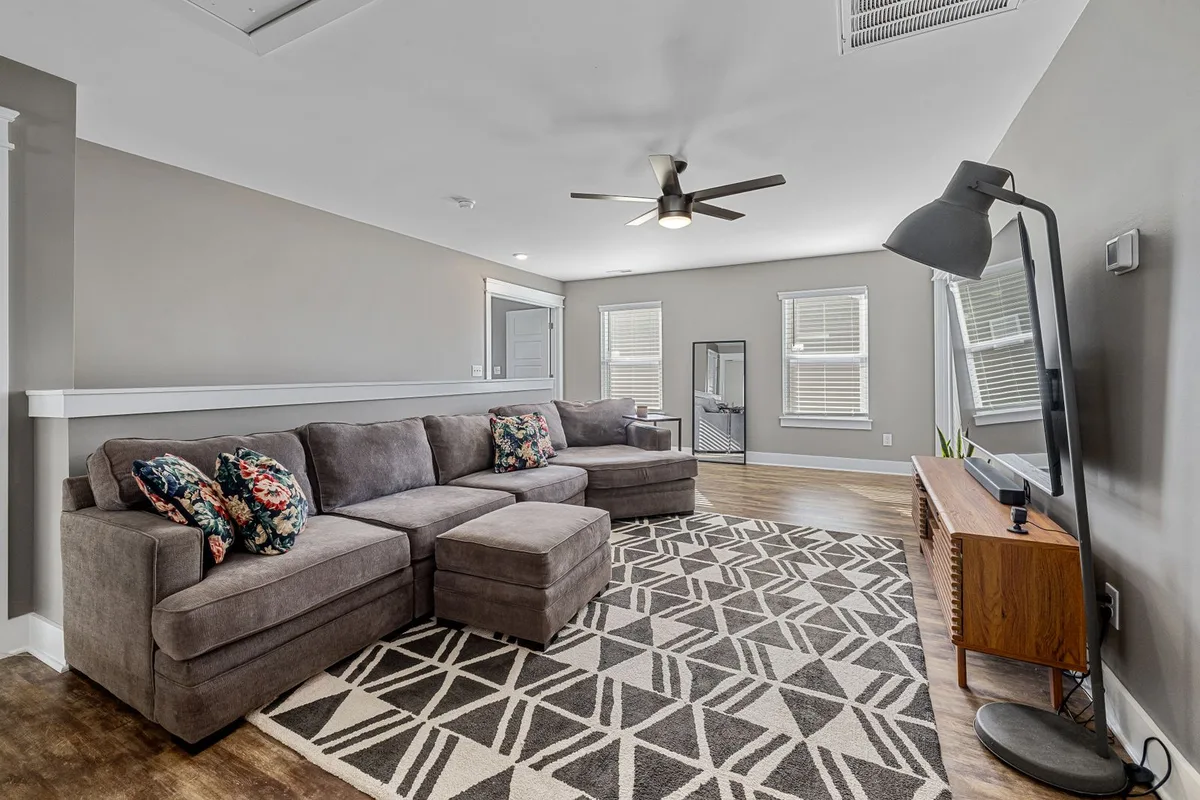
Why infrared still makes sense in a big room
If all 1500-watt heaters make the same heat, why pick infrared? Because of where the heat goes.
A quartz infrared element gives off radiant heat, the same kind you feel from sunshine. It warms you, the couch and the floor in front of it rather than only the air. In a big room, especially one with a tall or vaulted ceiling, warm air rises and pools up high where nobody is sitting. Radiant heat aimed at the seating area is felt sooner and wasted less.
Most “infrared” cabinet heaters, including three of the four below, also have a fan that pushes air over the hot element. You get a mix of radiant warmth up close and warm air for the rest of the room. That mix is what you want in a large space.
Compare at a glance
| Heater | Power | Heat type | Thermostat | Extras |
|---|---|---|---|---|
| Dr Infrared DR-968 | 1500W | Quartz infrared + PTC, fan | Yes, with Eco mode | 12-hour timer, remote, washable filter |
| Dr Infrared DR-998 | 1500W | Quartz infrared + PTC, fan | 50 to 85°F | Oscillation, humidifier, remote |
| Duraflame DFI-550-22 | 1500W | Infrared quartz, fan | Yes | Flame effect, remote |
| Heat Storm HS-1500-PHX-WIFI | 1500W | Quartz infrared, fan | Yes | Wall mount, Wi-Fi app, remote |
Specs come from each heater's manual or listing. All four plug into a standard 120-volt outlet and draw about 12.5 amps on high.
How we chose these
We haven’t run these heaters in our own house. We read the manuals and spec sheets, compared the heating elements, controls and safety features, and confirmed each exact model is listed on Amazon. Then we filtered for what matters in a large room:
- A real thermostat. In a big room you want the heater to hold a temperature, not just blast and shut off.
- A fan as well as an infrared element. Pure radiant heaters are great for one chair. A large room needs some moving air too.
- Tip-over and overheat protection on the floor models, and safe clearances you can actually meet.
- Coverage claims we could explain. We skipped heaters that promise whole-house heat from a single plug.
Read more about how we pick products.
1. Dr Infrared Heater DR-968 1500W Portable Infrared Heater: Best overall
Who it’s for: Living rooms, basements and home offices where you want steady, quiet extra heat and don’t care what the box looks like.
The DR-968 is the plain wood-grain cabinet on casters that you’ve probably seen in a relative’s living room. Inside are two heating elements: an infrared quartz tube and a PTC ceramic element, with a blower pushing air across both. The manual lists 1500 watts, 12.5 amps and 5,200 BTUs. You get an electronic thermostat with High, Low and an Eco mode, a 1 to 12 hour timer and a remote.
The thermostat is what makes it good for a big room. Set it to 70°F and it runs on High until the room gets there, then drops to Low and cycles to hold the temperature. The manual says the factory default is 68°F. The rear filter is electrostatic and washable. Dr. Infrared says to vacuum it about once a month, which keeps the heater from overheating and shutting itself off.
What bugs us: It’s 1500 watts, same as every heater on this list, so don’t expect it to heat an open floor plan by itself. The cabinet is about 23.5 pounds according to the manual, and the look is pure 1990s.
Skip it if: you need floor space more than portability. The Heat Storm goes on the wall.
2. Dr Infrared Heater DR-998 Infrared Heater with Humidifier: Best for dry winter air
Who it’s for: Wide rooms where heat needs to reach more than one couch, and homes where winter air already feels dry.
The DR-998 uses the same quartz infrared plus PTC heating as the DR-968, then adds two things that help in a large room. First, oscillation. The louvers sweep the warm air from side to side, so the heat isn’t one hot column aimed at a single spot. Second, a small cool-mist humidifier fed by a water bottle on the side. Dr. Infrared lists a thermostat range of 50 to 85°F, a 1 to 12 hour timer and a remote, and the fan can run with or without the humidifier.
Heated winter air is dry air, and a little added moisture makes a room feel warmer at the same temperature. That’s a real reason to pick this one over the DR-968 if you wake up with a dry throat.
What bugs us: The humidifier is small. It’s a nice extra, not a replacement for a proper room humidifier, and you’ll be refilling the bottle.
Skip it if: your home already runs humid in winter or you have a whole-house humidifier on the furnace.
3. Duraflame DFI-550-22 Infrared Quartz Electric Stove Heater: Best with a flame look
Who it’s for: Family rooms and dens where you want something that looks like a small wood stove, not a space heater.
This is a black, cast-iron-style stove with a door, a log set and a flickering flame effect behind the glass. Underneath is an infrared quartz heater with a fan, rated at 1500 watts and 5,200 BTUs. Duraflame lists it for supplemental heat in rooms up to 1,000 square feet, which you now know means topping up a room that already has heat. It comes with a remote and an adjustable thermostat, and the flame effect can run on its own with the heat off, so you can use it as decor in spring.
What bugs us: You pay for the looks. The heat output is the same as the plain Dr Infrared boxes, so if you only care about warmth, the DR-968 does the same job for less.
Skip it if: the heater is going in a basement or office where nobody will look at it.
4. Heat Storm HS-1500-PHX-WIFI Infrared Wall Heater: Best wall-mounted
Who it’s for: Big rooms with kids, pets or not much spare floor, and anyone who wants the heat on a schedule.
The Phoenix is a slim white heater, about 19 by 16 inches and 4 inches deep, that screws to the wall with the included hardware. It uses a quartz infrared element with a fan, has two heat settings and weighs about 8.5 pounds according to Heat Storm’s manual. The Wi-Fi version lets you set the temperature and schedules from your phone, so the room can be warm before you get up. Heat Storm rates it for supplemental heat in rooms from 150 to 750 square feet.
Getting the heater off the floor is a real advantage in a busy room. No cord across the walkway, nothing for a dog to knock over, and no heater sitting in front of the couch.
What bugs us: It has to be mounted on a wall. The manual doesn’t allow standing it up or propping it against something. The cord is only about 3 feet, so you’ll need an outlet right below where it goes. The warranty is 1 year.
Skip it if: you want to move the heater from room to room. Pick the DR-968.
How to get the most from one heater in a big room
- Put it where you sit, not in the middle of the room. Aim it at the couch or desk. Radiant heat works best in a line of sight.
- Close what you can. Shut doors to rooms you aren’t using and pull curtains at night. A big room with a wall of glass loses heat fast.
- Use a ceiling fan on low, in reverse. Clockwise on most fans pushes the warm air that collects near a high ceiling back down the walls.
- Run two heaters on two circuits if one isn’t enough. Two 1500-watt heaters on the same circuit will trip the breaker. Check which outlets share a breaker first.
- Keep 3 feet clear. Both the Dr Infrared and Heat Storm manuals say to keep curtains, furniture and anything that can burn at least 3 feet from the front of the heater.
Safety rules that apply to all of them
- Plug straight into the wall. Every one of these manuals says no extension cords and no power strips. A 1500-watt heater pulls 12.5 amps for hours, which is more than many cords can handle.
- Give each heater its own circuit if you can. Heat Storm’s manual says each heater should be on its own circuit. At minimum, don’t run a heater on the same circuit as a microwave or hair dryer.
- Feel the plug. If the plug or outlet gets hot, stop using that outlet and have it checked.
- Clean the filter. A clogged filter makes cabinet heaters overheat and shut off. Vacuum it monthly in heating season.
Quick answers
Can an infrared heater heat a 1,000-square-foot room? Not by itself. A 1500-watt plug-in heater makes about 5,100 BTUs an hour, enough to be the only heat in roughly 150 square feet. The “up to 1,000 square feet” claims mean supplemental heat in a room your furnace already warms.
Are infrared heaters cheaper to run than other space heaters? Per hour, no. All 1500-watt heaters use 1.5 kWh an hour on high, about 25 cents at 17 cents per kWh. Infrared can save money by letting you heat just the part of the room you’re in and turn the main thermostat down.
Is it safe to leave an infrared heater on overnight? These have thermostats, timers, tip-over switches (on the floor models) and overheat protection, and the manuals allow normal unattended use with the clearances followed. Still, never run a space heater on an extension cord, and keep 3 feet clear in front of it.
Infrared or oil-filled radiator for a big room? An oil-filled radiator is silent and gives gentle, even heat, but it’s slow to warm up and heats air rather than people. In a big room with a high ceiling, an infrared heater with a fan warms you faster.
We may earn a commission if you buy through links on this page. It never changes what we recommend. As an Amazon Associate we earn from qualifying purchases. Learn more.