Best Solar Pathway Lights That Stay Bright
Most solar path lights look great for a month and then fade by 9 p.m. Here are four that are built to last the night, from a 200-lumen Linkind set to a motion-activated Ring light, plus what actually keeps solar lights bright in winter.

We may earn a commission if you buy through links on this page. It never changes what we recommend. As an Amazon Associate we earn from qualifying purchases. Learn more.
Our top picks at a glance
- Check Amazon Price
A bright, simple path light with a 200-lumen high mode, a 12-hour low mode and four stake heights, at a fair price per light. Read more
Pros
- Up to 200 lumens on High
- Up to 12 hours on Low
- Four height options
- Warm white light
Cons
- Only 6 hours on High
- Splash resistant (IP54) rather than fully waterproof
- Check Amazon Price
A smarter, tougher path light with MPPT solar charging, USB-C backup charging for cloudy weeks and an app for schedules and color. Read more
Pros
- Up to about 14 hours of runtime
- USB-C charging when the sun won't cooperate
- IP67 weather rating
- Warm or cool white plus color
Cons
- About $100 for four
- 60 lumens is softer than the SP3 on High
- Check Amazon Price
Path lights that stay dim or off until someone walks by, then jump to 80 lumens. The Bridge links them to the Ring app. Read more
Pros
- Up to 80 lumens when motion is detected
- 15-foot motion range
- IP66 weather rating
- Ring Bridge included
Cons
- Pricier per light
- Smart features need the Bridge or a Sidewalk hub
- Check Amazon Price
A classic lantern-style light with a glass cup and stainless steel cap and stake, for a soft decorative glow along a garden path. Read more
Pros
- Glass and stainless steel build
- Standard AA rechargeable battery you can replace
- 8 to 10 hours of light
- IP65 rated
Cons
- Decorative glow, not bright task light
- Brightness isn't listed in lumens
Solar path lights have a reputation problem. Most of the cheap ones you see in big multipacks run on a tiny battery and a solar panel the size of a postage stamp. They look fine in June, then by November they glow like a dying candle and quit before you take the trash out.
The good news is that the gap between a dim set and a bright set usually comes down to a few specs you can check before you buy: how many lumens the light puts out, how big the battery is, and how well the panel charges on a gray day. These four sets come from brands that publish those numbers, and all four were listed in stock on Amazon this week.
Compare at a glance
| Light | Brightness | Rated runtime | Weather rating | Charging |
|---|---|---|---|---|
| Linkind SP3 | Up to 200 lumens (High) | 6 hrs High, 12 hrs Low | IP54 | Solar |
| Linkind SP6 | 60 lumens | Up to about 14 hrs | IP67 | Solar (MPPT) + USB-C |
| Ring Solar Pathlight | Up to 80 lumens on motion | Depends on settings and sun | IP66 | Solar + Micro USB |
| GIGALUMI Metal and Glass | Not listed (soft glow) | 8 to 10 hrs | IP65 | Solar, AA 600mAh battery |
Brightness, runtime and ratings come from each maker's own specs. Runtime is always "up to" and drops in winter.
How we chose these
We haven’t set these lights up in our own yard. Instead, we went through the makers’ spec sheets and product pages, looking for lights that publish real brightness, battery and runtime numbers rather than just calling themselves “super bright.” Then we checked that each set was sold on Amazon and in stock, and we read through owner reviews to spot common complaints, like lights dying early or water getting in.
What we looked for:
- A brightness number. A typical bargain solar stake puts out somewhere in the single digits of lumens. That’s enough to mark the edge of a path, not to see where you’re stepping. Anything in the dozens of lumens is a real path light.
- A long runtime on a modest setting. Lights with two or more modes let you trade brightness for hours. That matters most in winter.
- Better charging. Bigger panels, MPPT charge controllers and a USB backup all help a light keep going through cloudy weeks.
- A weather rating. IP65 and up means the light is sealed against rain and hose spray. IP54 means splash resistant.
Read more about how we pick products.
1. Linkind SP3 Solar Pathway Lights (8-Pack): Best overall
Who it’s for: Anyone who wants a path that’s actually lit, not just outlined, without paying smart-light prices.
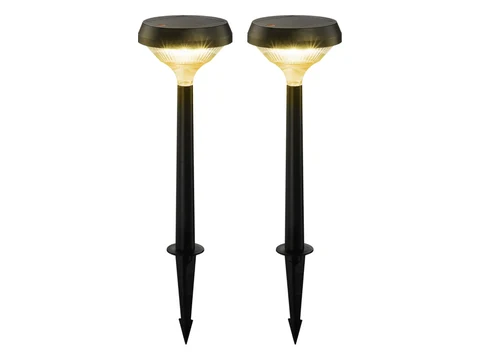
The SP3 is a plain black stake light with a wide, round head that throws light down and out onto the ground around it. Linkind rates it at up to 200 lumens in High mode, which is far brighter than most solar stakes. A button on top cycles through three modes. Linkind rates High at up to 6 hours, Low at up to 12 hours, and a slow “breathing” mode at up to 12 hours. It turns on at dusk and off at dawn on its own.
The stake comes in sections, so you can set each light at one of four heights, from about 8½ inches up to about 17 inches. That’s handy if you have tall plants along the walk, or you want the lights low and tucked under shrubs.
What bugs us: Six hours on High means the lights will often run out before morning, especially in winter, so most people will end up on Low for everyday use. Linkind’s own spec table rates the SP3 IP54, which is splash resistant, not fully sealed. It’ll handle rain, but don’t put it where water pools. The warranty is one year.
Skip it if: you want the lights to stay on all night through the darkest months. The SP6 is the better bet.
2. Linkind SP6 Smart Solar Pathway Lights (4-Pack): Best for winter and short days
Who it’s for: Yards that don’t get much sun in winter, and anyone who wants to set schedules or change the color for holidays.
The SP6 tackles the biggest weakness of solar lights, which is running out of charge, in two ways. It uses an MPPT charge controller, which gets more energy out of the panel than the basic charging circuits in most solar stakes, and Linkind rates it at up to about 14 hours of runtime. And if you hit a stretch of gray days, you can top it up with a USB-C cable instead of waiting for the sun.
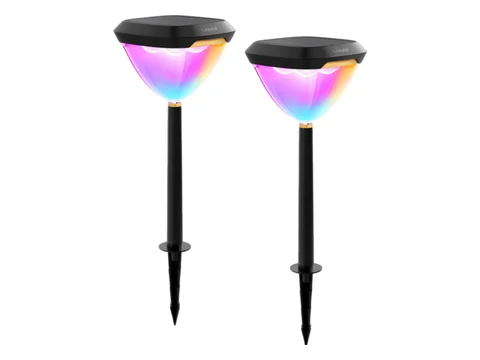
It puts out 60 lumens, either tunable white from warm to cool or full color. You control it through Linkind’s AiDot app over Bluetooth, so no Wi-Fi is needed in the yard. The app handles schedules, brightness and groups of lights. Each light also takes swappable lenses that throw patterns onto the ground, which is mostly a party trick, but some people love it at Halloween and Christmas. It’s rated IP67, the highest of the lights here.
What bugs us: At about $100 for four, it’s the most expensive per light of our picks. At 60 lumens it’s a softer light than the SP3 on High, though it should hold that brightness longer. Voice control with Alexa or Google needs a separate Bluetooth hub. Linkind’s spec table lists a three-year warranty, but some Amazon listings say two, so check the listing you buy from.
Skip it if: you just want warm white light and don’t care about apps. The SP3 is cheaper and brighter.
3. Ring Solar Pathlight 2-Pack with Ring Bridge: Best motion-activated
Who it’s for: Driveways and side paths where you’d rather have the light come on when someone walks up, and Ring camera owners who want lights that tie into the same app.
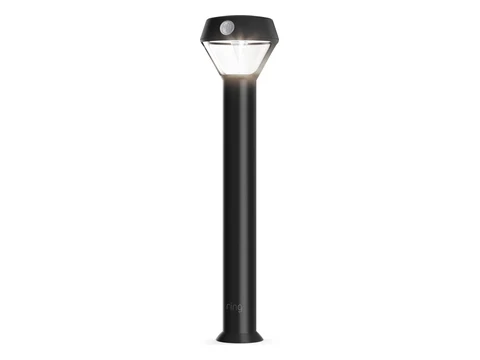
Ring’s Solar Pathlight works differently from a regular dusk-to-dawn stake. It sits dark, or at a dim glow if you set one, until its motion sensor picks up movement within about 15 feet. Then it jumps to up to 80 lumens. Because it isn’t lit all night, the battery has an easier job, and the light is brighter when it matters. It runs on a rechargeable 18650 lithium-ion battery charged by a small built-in solar panel, and you can also charge it over Micro USB. It’s rated IP66 and for temperatures from -4°F to 122°F.
This bundle includes the Ring Bridge, which connects the lights to the Ring app. With it, you can set brightness, schedule a dusk-to-dawn glow, link lights so they all turn on together, and get alerts when one detects motion. Without a Bridge or another compatible Amazon Sidewalk hub, Ring says the lights work only as standard motion lights.
What bugs us: Ring doesn’t give a runtime in hours, because it depends on how often the light triggers and how much sun the panel gets. Ring also warns that letting motion trigger the lights during the day drains the battery, so it’s worth setting them to work only after dark. It costs more per light than the Linkind sets, and the warranty is one year.
Skip it if: you want a path that’s softly lit all evening for looks. Motion lights are about safety, not ambiance.
4. GIGALUMI Metal and Glass Solar Pathway Lights (6-Pack): Best looking
Who it’s for: Garden beds, front walks and anyone who cares as much about how the lights look in daylight as at night.
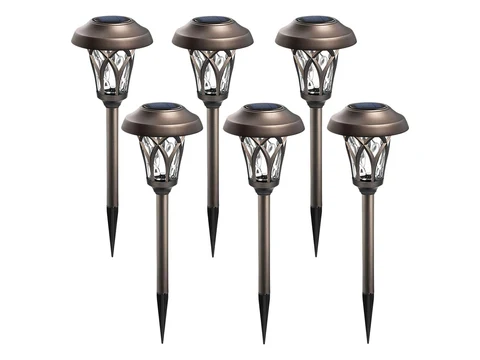
These are the classic lantern-style path lights: a brown cap with the solar panel on top, a patterned shade, a glass cup around the LED and a stainless steel stake. They look a lot less like plastic than most solar stakes, and the pattern throws a pretty shadow on the ground. GIGALUMI says they run 8 to 10 hours after 6 to 8 hours of sun, and rates them IP65.
One thing we like is the battery. These use a standard AA 600mAh rechargeable battery. Rechargeable AAs wear out after a few seasons, and when that happens here you can swap in a new one for a couple of dollars instead of throwing the light away. Many cheaper and sealed solar lights don’t give you that option.
What bugs us: GIGALUMI doesn’t list a lumen rating on this set, and this style of light is made to glow, not to flood a path with light. Think of it as marking the path’s edges. If you need to see where you’re stepping, pair a few of these with brighter lights, or go with the SP3.
Skip it if: brightness is the reason you’re shopping. These are about looks.
How to keep solar path lights bright
Even good solar lights fade if they’re set up in the wrong spot. A few habits make a big difference:
- Give them direct sun. The panel needs open sky, ideally six hours or more of direct sun. Lights under trees, eaves or on the north side of the house will always struggle. Remember that the sun sits lower in winter, so a spot that’s sunny in July may be shaded in December.
- Keep them away from other lights. Solar lights turn on when their sensor sees darkness. A porch light, streetlight or motion floodlight shining on them can keep them from switching on, or make them switch off early.
- Wipe the panels. Dust, pollen, hard-water spots and fallen leaves cut charging. A damp cloth every few weeks helps, and brushing off snow matters in winter.
- Use the low mode in winter. Shorter days mean less charge. If your lights die by midnight, switching to a lower setting usually gets you through the night.
- Replace worn batteries. If a light that used to last all night now quits early, the rechargeable battery is often worn out. Lights with a standard AA or AAA can take a fresh rechargeable of the same type and size. Don’t use regular alkaline batteries in a solar light.
Frequently asked questions
How many lumens do solar pathway lights need?
For marking the edge of a path, a few lumens per light is enough. To actually see the ground and any steps, look for lights in the 30 to 200 lumen range. Brighter lights usually run fewer hours on a charge, which is why lights with a high and low mode are handy.
Why do my solar lights die so early in winter?
Shorter days and a lower sun mean the panels collect less energy, while longer nights ask the battery to run more hours. Cold weather also cuts battery capacity. Move lights to the sunniest spot you have, clean the panels and use a lower brightness setting. Lights with USB charging, like the Linkind SP6, can be topped up on long cloudy stretches.
How far apart should solar path lights be?
A common starting point is about 6 to 8 feet apart along a path, staggered on both sides for wider walks. Brighter lights like the Linkind SP3 can go farther apart. Dimmer decorative lights look better a little closer together.
Can solar path lights stay out all winter?
Lights with a good weather rating, IP65 or higher, are made to stay outside year-round. If you get heavy snow, keep the panels clear, and consider pulling the lights during the worst of winter so a snow plow or shovel doesn’t knock them over.
How long do solar path lights last?
The LEDs themselves last many years. The rechargeable battery is usually what goes first, often after a couple of seasons. Lights with a replaceable battery can keep going much longer.