Best Kegerators for Home
Our picks for a home kegerator from Kegco and EdgeStar: a dual-tap all-rounder, a 20-inch full-size unit, a compact sixth-barrel fridge, a built-in model and a homebrew setup. Plus keg sizes, couplers and what to measure first.

We may earn a commission if you buy through links on this page. It never changes what we recommend. As an Amazon Associate we earn from qualifying purchases. Learn more.
Our top picks at a glance
- Check Amazon Price
A 24-inch dual-tap kegerator with a digital thermostat that holds a full-size keg or three 5-gallon kegs. Read more
Pros
- Two taps
- Digital temperature control down to 32°F
- Holds a full-size keg or three 5-gallon kegs
Cons
- CO2 tank ships empty
- 24 inches wide
- Check Amazon Price
A slimmer 20-inch single-tap kegerator that still fits a full-size half-barrel keg. Read more
Pros
- Only about 20 inches wide
- Fits a full-size keg
- Casters for moving it
Cons
- Single tap
- No digital temperature display
- Check Amazon Price
A compact kegerator for one sixth-barrel or 5-gallon keg, about 18 inches wide and deep. Read more
Pros
- Small footprint
- Cools to 32°F
- Locking door
Cons
- Won't fit a full-size keg
- Small 2.5 lb CO2 tank
- Check Amazon Price
A front-venting 24-inch kegerator made to slide under a counter, with an air-cooled tower and a stainless interior. Read more
Pros
- Front venting for under-counter installs
- Air-cooled tower cuts foam
- Stainless steel interior
Cons
- Costs about twice as much as a freestanding unit
- Check Amazon Price
The K309 cabinet set up for ball-lock homebrew kegs, with a range that goes warm enough to ferment. Read more
Pros
- Two ball-lock taps
- 32°F to 75°F range
- Holds three 5-gallon Corny kegs
Cons
- No D coupler for store-bought kegs
- CO2 tank ships empty
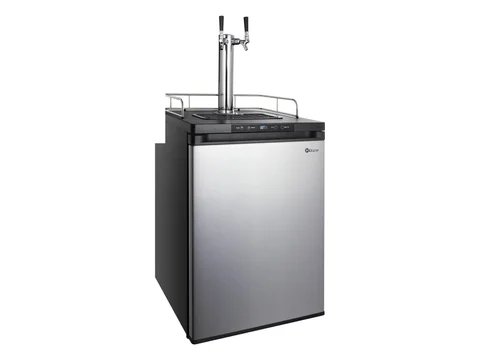
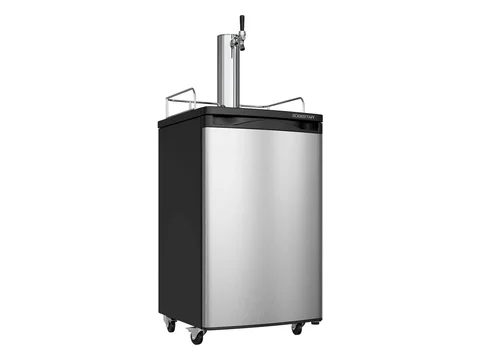
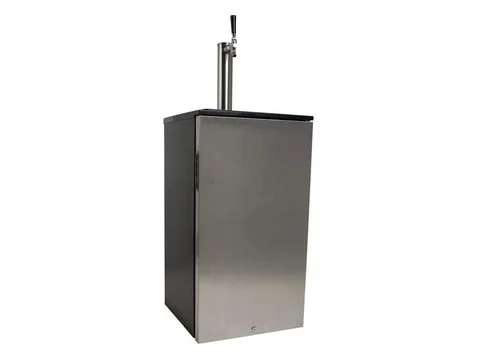
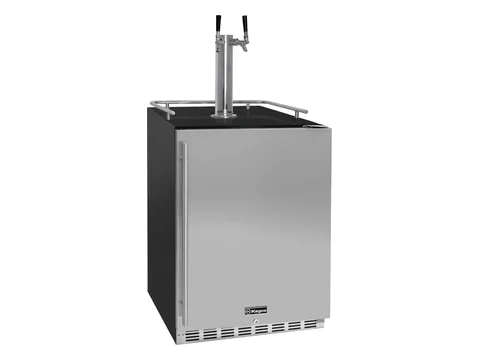
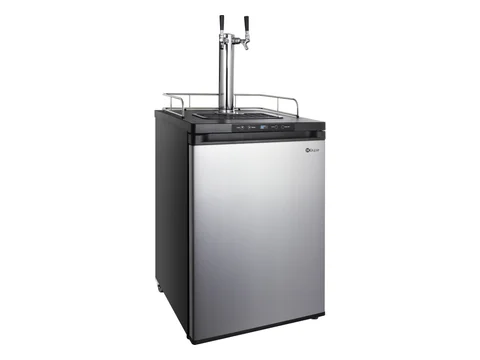
A kegerator is a small fridge with a tap tower on top, a CO2 tank inside and a keg in the middle. It keeps a keg cold for weeks and pours draft beer at home, which costs less per glass than cans once you buy beer by the keg.
Before you look at brands, answer two questions. What size keg will you buy? A full-size (half-barrel) keg needs a 20- to 24-inch-wide kegerator. A sixth barrel or 5-gallon homebrew keg fits in something much smaller. Will it stand on its own or go under a counter? A freestanding kegerator vents from the back and sides, so it needs space around it. Building one in needs a front-venting model.
At a glance
| Kegerator | Taps | Biggest keg | Width | Thermostat | Install |
|---|---|---|---|---|---|
| Kegco K309SS-2 | 2 | Full size, or three 5-gal | 24” | Digital, from 32°F | Freestanding |
| EdgeStar KC2000SS | 1 | Full size | 20.2” | Manual, no display | Freestanding |
| EdgeStar KC1000SS | 1 | Sixth barrel or one 5-gal | 17.7” | Digital, from 32°F | Freestanding |
| Kegco HK38BSU-2 | 2 | Full size, or three 5-gal | 24” | Digital, 32°F to 59°F | Built-in or freestanding |
| Kegco HBK309S-2 | 2 | Three 5-gal ball lock | 24” | Digital, 32°F to 75°F | Freestanding |
Specs come from Kegco's and EdgeStar's own product pages and listings, and from Home Depot's spec sheets for the EdgeStar models. Widths are rounded to the nearest tenth of an inch.
1. Kegco K309SS-2 Dual Tap Digital Kegerator: Best overall
Good fit for: Most people who want draft beer at home and might want two kinds on tap.
Kegco’s K309SS-2 is the kegerator to start with if you have the room. It takes any full-size keg, including the rubber-sided and Coors and Miller kegs that some cabinets won’t fit. Or it holds up to three 5-gallon kegs, so two taps can pour two different beers. A fan moves cold air around the cabinet, the digital controls go down to 32°F, and a Deep Chill button runs the compressor nonstop to pull a warm keg down to temperature faster.
It comes with what you need to pour: a double-faucet tower, two D-system couplers for most American commercial kegs, a regulator, air line and a 5 lb aluminum CO2 tank. With the tower off and the two shelves in, it works as a regular beverage fridge. Kegco covers parts and labor for a year and the compressor (parts only) for five.
What bugs us: The CO2 tank ships empty, so plan a trip to a welding supply, homebrew store or beverage distributor to fill it before your first keg. At 24 inches wide and about 33 inches tall, it’s a big box for a small kitchen.
Skip it if: you only ever buy one kind of beer and want the narrowest full-size kegerator you can find. Look at the EdgeStar KC2000SS instead.
2. EdgeStar KC2000SS Full Size Kegerator: Best value full-size
Good fit for: One-tap households that want a full-size keg in less floor space.
The KC2000SS is about 20 inches wide, roughly 4 inches narrower than the Kegco, and it still holds a full-size half-barrel keg. Retailer listings put its low end in the low 30s. It rolls on casters, so you can pull it out to swap a keg, and it has a drip tray and a guard rail on top.
EdgeStar also sells this cabinet as a dual-tap version (KC2000SSTWIN) if you want two taps without going to 24 inches wide.
What bugs us: It has one tap and no digital temperature display (EdgeStar saves that for its pricier KC3000), so you set it by feel and check with a thermometer in a glass of water. Some retailers have stopped carrying certain KC2000 versions, so check the exact model number on the listing before you buy.
Skip it if: you want two taps. The K309SS-2 or the KC2000SSTWIN make more sense.
3. EdgeStar KC1000SS Craft Brew Kegerator: Best for small spaces
Good fit for: Apartments, dens and anyone who buys smaller craft kegs.
The KC1000SS is built for one sixth-barrel keg or one 5-gallon Cornelius keg, with the CO2 tank inside. It’s about 17.7 inches wide and 18.3 inches deep, small enough to tuck beside a couch or at the end of a counter. An internal fan keeps the temperature even, and EdgeStar says it holds as low as 32°F without freezing the keg. It has a digital thermostat, blue interior LEDs, a reversible door and a lock.
It comes with a stainless tower and faucet, a 2.5 lb CO2 tank (empty), a regulator, a D coupler and the lines.
What bugs us: A full-size keg won’t fit, and many breweries and liquor stores only stock domestic beer in half barrels. Ball-lock homebrew kegs need a separate conversion kit. The 2.5 lb tank means more refill trips than a 5 lb tank.
Skip it if: you mostly buy big kegs of domestic beer for parties.
4. Kegco HK38BSU-2 Built-In Dual Tap Kegerator: Best built-in
Good fit for: Home bars and kitchen remodels where the kegerator goes under the counter.
Most kegerators breathe out the back and sides, so boxing one into cabinets can make it overheat. The HK38BSU-2 vents out the front, so Kegco says you can build it into cabinetry. It still works freestanding, with a stainless guard rail on top. It also blows cold air up into the tower, which keeps the beer lines cold to the faucet. Warm lines are a big cause of foamy first pours.
The interior is stainless steel instead of plastic and fits a full-size keg, two quarter slims or up to three 5-gallon kegs. The door locks, and an alarm sounds if it’s left open. Digital controls up front set it between 32°F and 59°F.
What bugs us: It costs about twice as much as the freestanding K309SS-2. It won’t take 50-liter European kegs. You’ll also need to plan the counter height and cutout around Kegco’s install guide before you order.
Skip it if: the kegerator will stand on its own. You’re paying a lot extra for the front venting.
5. Kegco HBK309S-2 Homebrew Dual Tap Kegerator: Best for homebrewers
Good fit for: People who keg their own beer, cider or kombucha.
This is the K309 cabinet set up for homebrew. It holds up to three 5-gallon ball-lock Corny kegs. The dual-gauge regulator lets you carbonate and serve, and two ball-lock tap sets come in the box. The digital thermostat goes from 32°F up to 75°F. At the top of that range, the cabinet works as a fermentation chamber that fits a 6-gallon bucket or carboy.
What bugs us: The couplers are for ball-lock kegs only. To tap a store-bought commercial keg, you’ll need to buy a D-system coupler separately. The CO2 tank ships empty here too.
Skip it if: you don’t brew. The standard K309SS-2 comes ready for commercial kegs.
How we picked

We focused on complete kegerators from Kegco and EdgeStar, two brands that sell many sizes. We left out conversion fridges that make you buy the tap kit separately. We checked keg capacity, temperature range, venting and what’s in the box against each maker’s product pages and spec sheets. We looked for:
- Keg fit: full size, sixth barrel or 5-gallon homebrew kegs
- Temperature control: how low it goes, and whether you can read the setting
- Taps: one or two
- Installation: freestanding, or front-venting for built-in use
- What’s included: tower, coupler, regulator and CO2 tank
We haven’t tested these kegerators ourselves. Read more about how we pick products.
Keg sizes and what fits
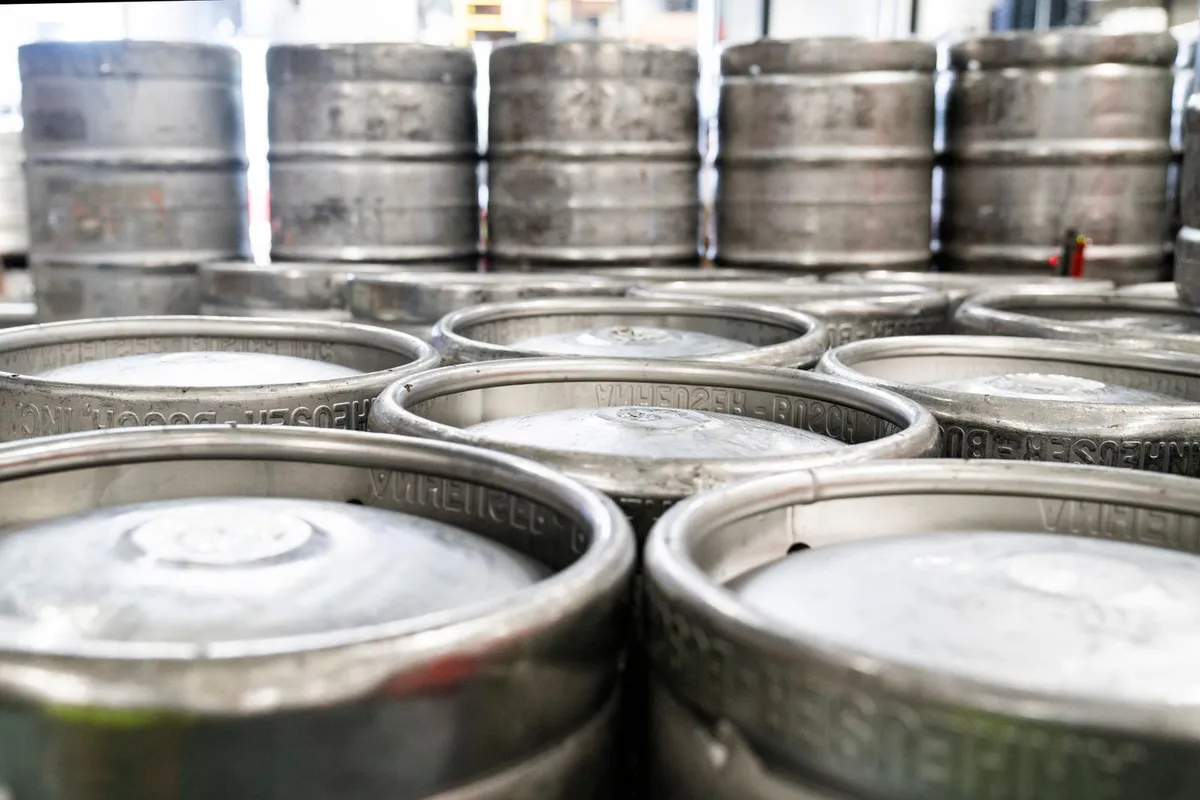
- Half barrel (“full size”): 15.5 gallons, about 165 twelve-ounce pours. This is the standard party keg and needs a 20- or 24-inch full-size kegerator.
- Quarter barrel slim: 7.75 gallons, about 82 pours. It’s tall and narrow, so it fits most full-size kegerators, sometimes two at a time.
- Sixth barrel: about 5.2 gallons, about 55 pours. Common for craft beer, and the size a compact kegerator like the KC1000SS is built around.
- Cornelius (“Corny”) keg: 5 gallons, used by homebrewers. It uses ball-lock or pin-lock fittings, not a commercial coupler.
What to know before you buy
- Check the coupler. Most American commercial kegs use a D-system (Sankey) coupler, which is what these kits include. Many European beers use other systems, and Guinness uses its own coupler and a nitrogen blend instead of straight CO2. Ask the store which coupler your keg needs.
- Measure the spot, including the tower. Add the tower height (often 12 to 14 inches) to the cabinet height if it’ll sit under a cabinet or shelf.
- Leave room to breathe. Freestanding kegerators need open air at the back and sides. Only front-venting models like the HK38BSU-2 should be boxed in.
- Plan for CO2 refills. Tanks usually ship empty. Welding supply shops, homebrew stores and beverage distributors fill or swap them.
- Clean the lines. Beer lines build up yeast and residue. Run line cleaner through them every couple of kegs, or about every two weeks of use, and the beer will taste better.
If you’re comparing these to a plain beverage fridge, our mini fridge size guide explains how cubic feet turn into cans and bottles.
Still wondering?
How long does a keg stay fresh in a kegerator? Most pasteurized domestic kegs stay good for a few months when kept cold under CO2. Unpasteurized craft beer is usually best within six to eight weeks. Ask the brewery for its own guidance.
Why is my beer so foamy? The most common causes are beer that’s too warm, a warm tower or lines, and the regulator pressure set wrong for your beer and line length. Let a new keg settle and chill for a day before you pour.
Can I put a kegerator in the garage? Only if it’s rated for it. Most indoor units are made for a heated room and can struggle in a hot or freezing garage. Kegco and EdgeStar sell separate outdoor-rated models.
Can a kegerator be used as a regular fridge? Yes. The kegerators here come with shelves, so you can remove the tower and cap the hole to use one as a beverage fridge between kegs.