Best Electric Snow Blowers: 4 Cordless and Corded Picks for Real Driveways
The best electric snow blowers for most homes, from a 21-inch EGO that clears like a small gas machine to a $300 corded Snow Joe. How to pick between battery and cord, plus who should still buy two-stage.

We may earn a commission if you buy through links on this page. It never changes what we recommend. As an Amazon Associate we earn from qualifying purchases. Learn more.

Our top picks at a glance
- Check Amazon Price
A single-stage machine with a steel auger and two 56V batteries that throws snow about 42 feet and handles the plow berm better than most battery blowers. Read more
Pros
- Steel auger
- Two 4.0Ah batteries and charger included
- Adjustable skid shoes
- Folds flat for storage
Cons
- Not self-propelled
- Pricier than other single-stage blowers
- Check Amazon Price
A light 18-inch blower for short driveways, walks and decks, sold as a kit with two batteries, a charger, a cover and an ice scraper. Read more
Pros
- About 37 lb
- Batteries and charger included
- Little assembly
- Low price for a cordless kit
Cons
- Clogs in wet snow
- Short throw
- Snags on cracks and uneven pavers
- Check Amazon Price
A 15-amp corded blower with a 22-inch path that never runs out of battery, for about the price of a single spare battery on other brands. Read more
Pros
- Runs as long as you need
- 22 x 13 inch path
- Dual LED lights
- Lowest cost per inch of width
Cons
- Cord management takes practice
- Needs a heavy outdoor extension cord
- Paved surfaces only
- Check Amazon Price
A self-propelled two-stage with two 10Ah batteries, heated grips and steering triggers, for snowbelt driveways where a single-stage will stall. Read more
Pros
- Throws up to 50 feet
- Heated grips
- Trigger steering
- Two 10Ah batteries included
Cons
- Costs about as much as a good gas two-stage
- Heavy at roughly 150 lb before batteries
Electric snow blowers used to be toys for clearing a dusting off the front steps. That’s no longer true. A good battery machine now clears a two-car driveway after a normal storm, and you don’t have to deal with gas, oil, pull cords or a carburetor that gums up over the summer.
They still have limits, though. Most electric blowers are single-stage, so they work best on paved surfaces and in snow under about a foot deep. Battery runtime drops in heavy, wet snow and in deep cold. The picks below are sorted by the kind of winter and driveway each one actually fits.
Compare at a glance
| Snow blower | Power | Type | Clearing width | Throw | Weight |
|---|---|---|---|---|---|
| EGO SNT2122 | 2 x 56V 4.0Ah | Single-stage | 21” | Up to 42 ft | About 50 lb (est.) |
| Snow Joe 24V-X2-SB18 | 2 x 24V 4.0Ah (48V) | Single-stage | 18” | Up to 20 ft | About 37 lb |
| Snow Joe SJ627E | 15-amp corded | Single-stage | 22” | Up to 25 ft | About 35 lb |
| EGO SNT2416 | 2 x 56V 10.0Ah | Two-stage | 24” | Up to 50 ft | About 147 lb without batteries |
Specs come from EGO, Snow Joe and authorized dealers. EGO hasn't published a weight for the 2026 SNT2122, so the estimate is based on the model it replaces.
How we chose these
We haven’t run these machines ourselves. We read through Bob Vila’s electric and cordless snow blower tests, which ran a dozen battery models through storms in Lake Tahoe and Montana down to -7°F, plus Family Handyman’s and Popular Science’s roundups. Then we checked every spec against the maker’s own listing and confirmed each pick was actually in stock on Amazon this week. A few favorites didn’t make it for that reason alone. The Toro 60V Power Clear and the Worx 40V were both out of stock on Amazon when we checked, and Ryobi’s two-stage blowers are sold only at Home Depot.
What we cared about:
- A steel auger, or a clear reason to skip one. Rubber paddles are fine for fluffy snow but wear quickly and struggle with the icy ridge at the end of the driveway.
- Batteries in the box. Several “bargain” blowers are bare tools, and two batteries can add $300 to $600.
- Honest runtime. Makers quote runtimes for 8 inches of light snow. We leaned on what testers actually got.
- A real throw. If snow only lands 15 feet away, you end up re-clearing it.
Read more about how we pick products.
1. EGO Power+ SNT2122 21-Inch Peak Power Snow Blower: Best overall
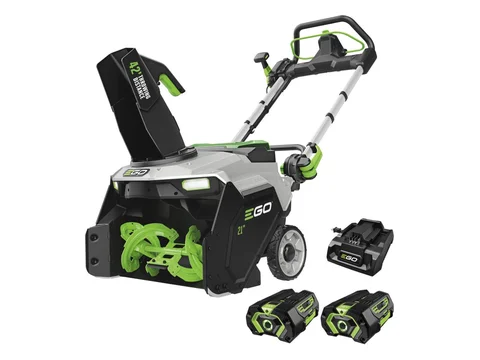
Who it’s for: Most people with a paved one- or two-car driveway who want to stop dealing with gas.
The SNT2122 is EGO’s 2026 update to the SNT2112, a single-stage blower that kept turning up at the top of testers’ lists. Bob Vila named the older model its best lightweight cordless blower, and testers said its steel auger chewed through heavy, wet snow and threw it close to the claimed 40 feet. The new version keeps the formula. It runs on two 56V batteries at once, which EGO calls Peak Power, and it has a 6-inch steel auger, a 21-inch path and a 13-inch intake. EGO rates the throw at up to 42 feet.
Two changes matter. The kit now ships with two 4.0Ah batteries and a charger, so there’s nothing else to buy. It also has adjustable skid shoes, which most single-stage blowers lack. They let you lift the auger slightly off uneven pavers and cracked concrete.
EGO says the included batteries clear about a 10-car driveway under 8 inches of snow. Expect much less in wet snow or deep cold, but it’s still enough for a typical driveway and walk in one go.
What bugs us: It isn’t self-propelled. The auger pulls it forward a bit, as single-stage augers do, but you still push it up a slope. Testers of the older model also found that the steel auger scrapes on rough pavement and that the chute can ice up below zero. A quick spray of silicone inside the chute solves the icing.
Skip it if: you regularly get storms over a foot deep, or you have a gravel driveway. You need two-stage for both.
2. Snow Joe 24V-X2-SB18 48-Volt IONMAX Snow Blower Kit: Best budget cordless
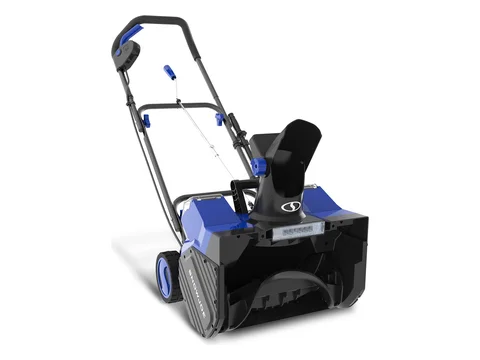
Who it’s for: Short driveways, sidewalks, decks and townhouse walks in places that get regular light snow.
Bob Vila picked this kit as both the best value cordless blower and the best for small driveways. In testing it cut an 18-inch-wide, 10-inch-deep path in a single pass through light snow, and the two 24V batteries together ran for about 40 minutes. It weighs about 37 pounds, so you can carry it up the porch steps or onto a deck. Assembly takes around five minutes.
The listing we link is Snow Joe’s bundle. Along with the blower, two 4.0Ah batteries and a dual-port charger, you get a weather cover and an ice scraper. Snow Joe says the batteries recharge in just under two hours. They also work in the rest of the company’s 24V tools.
What bugs us: Testers found that the chute clogged in wet snow. A clean-out tool is included, and a coat of non-stick spray helps. It also catches on raised pavement edges and feels tippy on uneven ground. Like most small blowers, it throws only about 20 feet.
Skip it if: your driveway is longer than about two car lengths or you get heavy, wet snow. The EGO costs more but handles both.
3. Snow Joe SJ627E 22-Inch Corded Snow Blower: Best corded
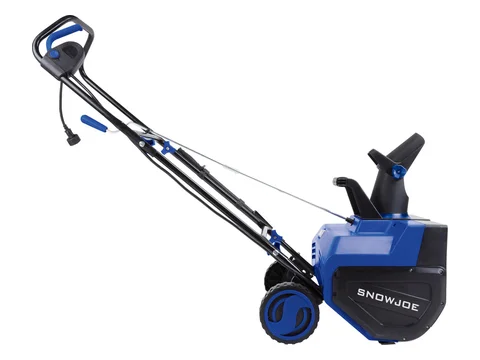
Who it’s for: Anyone with an outdoor outlet near the driveway who would rather manage a cord than pay for batteries.
A corded blower is the cheapest way into a wide electric machine, and it never runs flat halfway down the driveway. The SJ627E has a 15-amp motor and cuts a 22-inch-wide, 13-inch-deep path. Snow Joe rates it at up to 840 pounds of snow a minute. The chute turns 180 degrees and throws up to 25 feet. You also get two LED headlights, a chute clean-out tool and a two-year warranty, and the blower weighs about 35 pounds.
Family Handyman’s testers noted that corded machines often do better than cordless ones in heavy, wet snow because they never sag as a battery drains. That’s the real case for going corded.
What bugs us: The cord. You need a heavy-gauge outdoor extension cord rated for cold, and Snow Joe says not to go longer than 100 feet. The trick is to start near the outlet and work away from it, throwing snow away from the cord. Once you get the hang of it, it’s routine. Until then, expect to run over the cord a time or two, so check it for nicks before every use.
Skip it if: your driveway is longer than about 100 feet from the nearest outlet, or the cord would cross a sidewalk other people use.
4. EGO Power+ SNT2416 24-Inch Two-Stage XP Snow Blower: Best for heavy snow
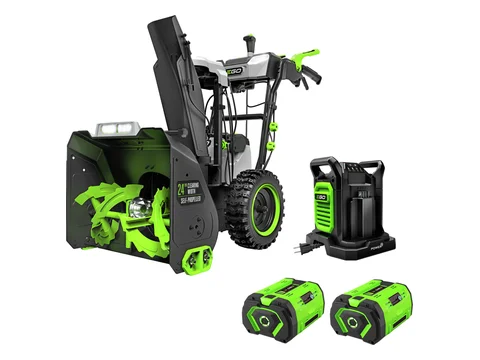
Who it’s for: Snowbelt homeowners who want to quit gas without giving up a real two-stage machine.
Bob Vila’s testers ran EGO’s 24-inch two-stage through more than two feet of snow and the plow mound at the end of the driveway, and the drive and auger never stalled. They said it worked as well as almost any gas machine they’d used. The SNT2416 is the XP version of that machine. It adds trigger steering, which brakes one wheel so a heavy blower turns easily, and a joystick that rotates and tilts the chute through 200 degrees. It also has heated grips, four LED lights and variable-speed drive in both directions.
It ships with two 10Ah batteries, the biggest EGO makes. EGO rates that pair for about a 24-car driveway under 8 inches of snow and says the blower throws snow up to 50 feet.
What bugs us: The price. At around $1,800 with batteries, it costs about as much as a well-equipped gas two-stage. It’s also heavy. Retailers list the tool alone at about 147 pounds, and each battery adds a few more.
Skip it if: your storms are usually under a foot. The SNT2122 does that work for less than half the money. If you want an EGO two-stage for a gravel driveway, our gravel driveway snow blower guide covers the SNT2400 bare tool.
Cordless or corded?
Go cordless if your driveway is far from an outlet, if you have steps or a deck to clear, or if you already own batteries from the same brand. Battery packs make up most of the cost of a cordless blower, so staying on one platform saves real money.
Go corded if your driveway is short, an outlet is close, and price matters most. A corded blower costs less than many single batteries and never runs out mid-job.
Either way, a single-stage electric blower is built for paved surfaces. Our single-stage vs two-stage guide explains where that line is.
Getting the most out of the batteries
- Store batteries indoors. A cold battery gives less runtime. Bring the packs inside after each use and put them in just before you head out.
- Go out mid-storm. Two passes through 6 inches each are far easier on the battery than one pass through a foot of settled snow.
- Slow down in wet snow. Pushing too fast loads the motor and drains the battery quickly. Take a narrower bite instead.
- Spray the chute. A light coat of silicone spray inside the chute and on the auger housing keeps wet snow from sticking and clogging.
Quick answers
Can an electric snow blower handle a foot of snow? A strong single-stage like the EGO can, if you take a narrow bite and go slowly. For a foot of snow every storm, get a two-stage.
How long do the batteries last? The makers’ numbers assume about 8 inches of light snow. In heavy, wet snow, testers often got half that. The Snow Joe ran about 40 minutes on two packs in Bob Vila’s testing.
Can I use an electric snow blower on gravel? Not a single-stage one. The auger touches the ground and throws stones. Use a two-stage with skid shoes set about an inch high.
What extension cord do I need for a corded blower? An outdoor cord rated for cold weather. For a 15-amp blower, use 12-gauge for runs over 50 feet and stay under the maker’s 100-foot limit.
At the end of the season, our guide to storing a snow blower for the off-season includes a section on battery models.