Knife Sharpeners for Home Cooks: The Highest-Rated Picks for 2026
Electric, pull-through, rolling or whetstone? Our picks for the best knife sharpeners at every budget, and how to choose the right type for your knives.

We may earn a commission if you buy through links on this page. It never changes what we recommend. As an Amazon Associate we earn from qualifying purchases. Learn more.
Our top picks at a glance
1 Best electric
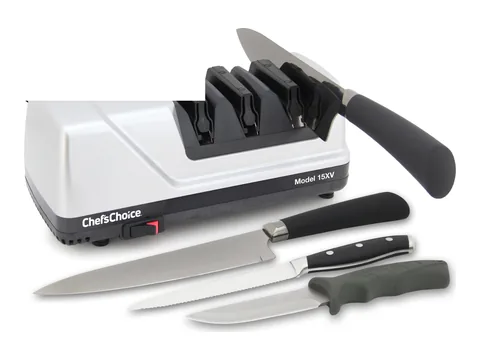
Chef'sChoice Trizor XV
About $165
Three guided stages put a sharp 15-degree edge on most kitchen knives in a couple of minutes. Read more
Pros
- Fast and very consistent
- Diamond abrasives
- Converts 20-degree knives to 15
Cons
- Pricey
- Less suited to small knives
- Removes more metal than a stone
2 Best manual pull-through
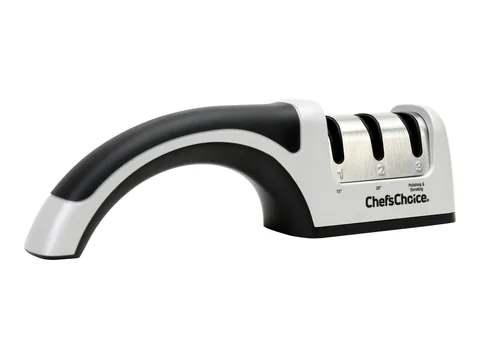
Chef'sChoice ProntoPro 4643
About $60 to $68
Diamond wheels with separate 15- and 20-degree slots, so it suits both Japanese and German knives. Read more
Pros
- Two angle options
- Handles serrated knives
- No power needed
Cons
- Slower than electric
- Takes a few passes to learn
3 Best budget
AccuSharp Knife & Tool Sharpener
About $12
A tiny handheld carbide sharpener that brings a dull knife back in seconds. Read more
Pros
- Very cheap
- Quick
- Works on serrated edges
Cons
- Aggressive on edges
- Not for premium knives
4 Best rolling sharpener
HORL 3 Cruise
About $119
A magnetic angle block and a rolling diamond disc make a precise edge easy for beginners. Read more
Pros
- Very beginner-friendly
- Gentle on blades
- Looks good on the counter
Cons
- No serrated knives
- Expensive for what it is
5 Best whetstone kit
Intelitopia Whetstone Set
Under $30
Four grits, an angle guide and a flattening stone, for anyone ready to learn the best method. Read more
Pros
- Sharpest possible edge
- Very low price
- Includes flattening stone
Cons
- Learning curve
- Slow and a bit messy
A sharp knife is safer and far more pleasant to use than a dull one, and you don’t need to spend much to keep yours that way. The right sharpener depends mostly on how much effort you want to put in and what kind of knives you own.
We compared the most recommended sharpeners of each type on how easy they are to use, the angle they sharpen to, whether they handle serrated knives, how hard they are on blades, and price.
The picks compared
| Sharpener | Type | Angle | Serrated? | Approx. price |
|---|---|---|---|---|
| Chef’sChoice Trizor XV | Electric, 3-stage | 15° | Refines only | $165 |
| Chef’sChoice ProntoPro 4643 | Manual pull-through | 15° and 20° | Yes | $60 to $68 |
| AccuSharp | Handheld carbide | Fixed | Yes | $12 |
| HORL 3 Cruise | Rolling, magnetic block | 15° and 20° | No | $119 |
| Intelitopia Whetstone Set | Whetstones | Any (guide included) | No | Under $30 |
Prices change often. These are typical prices we saw in October 2026.
How we chose these
We started with the sharpeners recommended most often by independent reviewers and test kitchens, then compared them across five things that matter most at home:
- Ease of use for someone who isn’t a knife expert
- Sharpening angle and whether it suits your knives
- Serrated knife support
- How much metal it removes, which affects how long your knives last
- Price
We haven’t tested these ourselves. We’ll update this guide as we use these sharpeners ourselves. Read more about how we pick products.
1. Chef’sChoice Trizor XV: Best electric sharpener
Best for: People who want a very sharp edge with the least effort.
The Trizor XV (also sold as the 15XV EdgeSelect) has been a long-standing favorite in test kitchens, including America’s Test Kitchen. Its three stages grind, hone and polish the edge using spring-loaded guides that hold the angle for you. It sharpens to 15 degrees, which means it can also convert older 20-degree German-style knives to a sharper, Japanese-style edge.
What bugs us: It’s expensive, and like all electric sharpeners it removes more metal than a whetstone, so your knives will wear a bit faster over the years. Reviewers note it’s less effective on small paring knives.
Skip it if: you own expensive Japanese knives you’d rather sharpen by hand, or you sharpen only once or twice a year.
2. Chef’sChoice ProntoPro 4643: Best manual pull-through
Best for: Anyone who wants good results without electricity or the learning curve of a stone.
This manual sharpener has diamond-coated wheels and three slots: one at 15 degrees for Japanese-style knives, one at 20 degrees for German-style knives, and a polishing stage. You simply pull the blade through a few times. It also handles serrated knives, which many sharpeners can’t.
What bugs us: It takes a few more passes than an electric model to bring back a very dull knife, and it helps to practice a steady, even pull.
Skip it if: you sharpen a lot of knives often. Electric will save you time.
3. AccuSharp Knife & Tool Sharpener: Best budget
Best for: People who want a cheap, quick fix for basic knives.
For about the price of lunch, the AccuSharp’s tungsten carbide blades scrape a fresh edge onto a dull knife in a few strokes. It’s small enough to keep in a drawer, works on serrated blades, and has a finger guard.
What bugs us: Carbide sharpeners are aggressive and take off more metal than other methods, and the edge isn’t as refined. Fine for inexpensive knives; not something we’d use on a good chef’s knife.
Skip it if: you’ve spent real money on your knives.
4. HORL 3 Cruise: Best rolling sharpener
Best for: Beginners who want precise results and like a tidy, good-looking tool.
Rolling sharpeners are a newer design. You stick the knife to a magnetic block that holds it at a fixed angle, then roll a diamond disc along the edge. Because the block holds the angle, it’s much easier to get consistent results than freehand on a stone, and it’s gentle on blades.
What bugs us: It can’t sharpen serrated knives, narrow blades can be awkward to mount, and it’s pricey compared with a pull-through sharpener that does a similar job.
Skip it if: you have serrated knives you want to keep sharp.
5. Intelitopia Complete Whetstone Set: Best whetstone kit
Best for: Cooks who want the best possible edge and don’t mind learning a skill.
Whetstones give you full control over the angle and remove the least metal, which is why most knife enthusiasts use them. This inexpensive kit includes four grits, a non-slip base, an angle guide to help beginners, and a flattening stone to keep the whetstones level over time.
What bugs us: There’s a learning curve, it’s slower than other methods, and it’s messy. The stones need soaking before use.
Skip it if: you want a 30-second job. Here’s our step-by-step whetstone guide if you want to try.
How to choose a knife sharpener
Electric
Fastest and most consistent, but the most expensive and hardest on blades over time. Best if you want sharp knives with no skill involved.
Manual pull-through
Inexpensive, compact and easy. Quality varies a lot: diamond or ceramic models are gentler than cheap carbide ones.
Rolling
Easy, precise and gentle, thanks to a magnetic angle holder. Usually can’t do serrated knives.
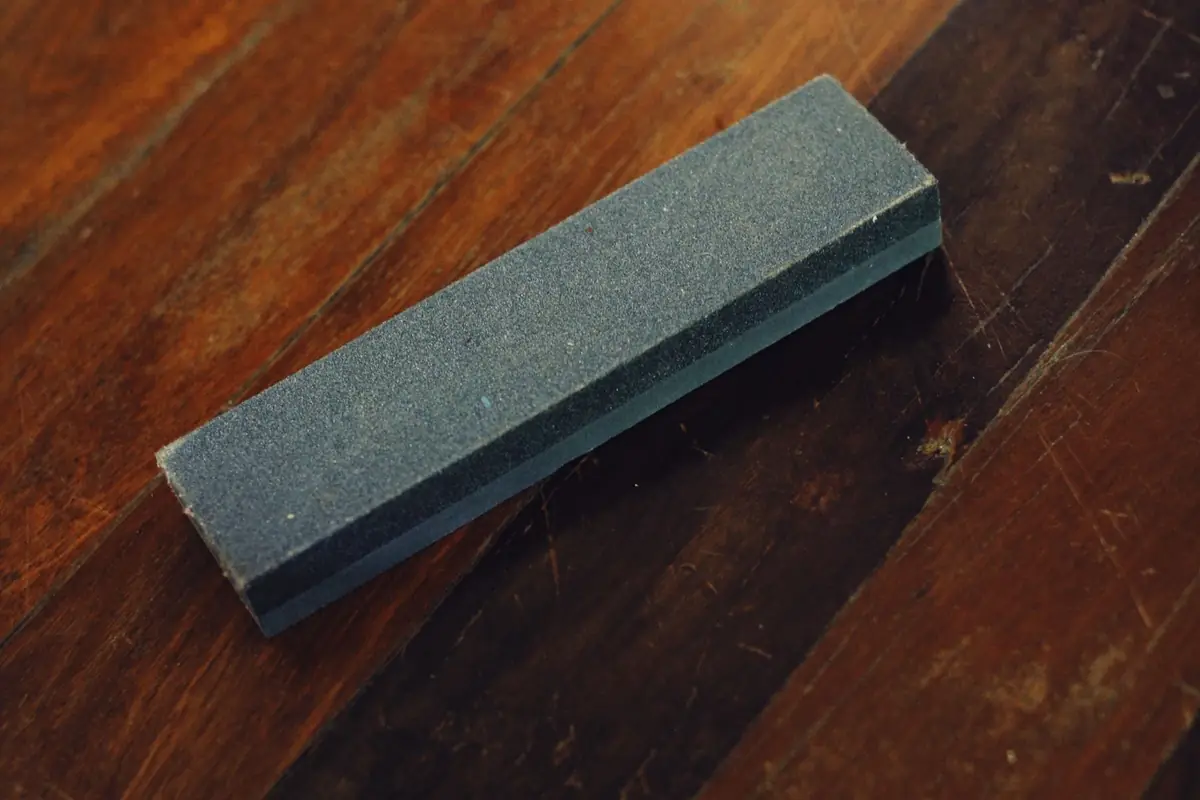
Whetstone
The best edge and the least metal removed, but it takes practice and time.
Match the angle to your knives
German-style knives (Wüsthof, Henckels and most Western brands) usually have about a 20-degree edge. Japanese knives are usually around 15 degrees. Sharpening a Japanese knife at 20 degrees will make it feel duller, so check what your knives need.
Don’t forget to hone
A sharpener isn’t something you need weekly. Between sharpenings, a few strokes on a honing rod keep the edge straight. Our honing vs sharpening guide explains the difference.
Common questions
How often should I sharpen my knives? For most home cooks, every 2 to 4 months, with regular honing in between.
Are pull-through sharpeners bad for knives? Cheap carbide ones can be rough on edges. Diamond or ceramic pull-through models are much gentler and fine for most kitchen knives.
Can I sharpen serrated knives? Yes, with a sharpener that supports them, like the ProntoPro or AccuSharp, or a tapered sharpening rod. Flat whetstones aren’t suited to serrated edges.
Which knives are worth sharpening by hand? Any knife you care about. If you’re building a set, here’s which kitchen knives you actually need.