Generator vs Power Station for a Winter Outage: Which One Should You Buy?
A generator or a power station for a winter power outage? We compare safety, runtime, cold weather, noise and cost, then name three of each worth buying, from the Westinghouse iGen5000DF to the Anker SOLIX C1000 Gen 2.


Our top picks at a glance
- Check Amazon Price
A dual fuel inverter generator with 3,900 running watts on gas, remote start and up to 18 hours on a tank. Read more
Pros
- 4.7 stars on 1,700+ ratings
- Gas or propane
- As low as 52 dBA
Cons
- About 105 lb
- About $949
- Check Amazon Price
A dual fuel inverter with CO Shield, which shuts the engine off if carbon monoxide builds up around it. Read more
Pros
- CO Shield auto shutoff
- Up to 21 hours on propane
- Parallel ready
Cons
- 61 dBA
- the loudest here
- About $985
- Check Amazon Price
3,400 running watts, electric start and an RV-ready 30-amp outlet for about $700. Read more
Pros
- 4.7 stars on 2,400+ ratings
- About $700
- Electric start
Cons
- Gas only
- 99.2 lb
- Check Amazon Price
1,024 Wh and 2,000 W of output, a full recharge in about 49 minutes, and 10 ms UPS switchover. Read more
Pros
- About $470
- Fastest recharge here
- 600 W solar input
Cons
- About 25 lb
- 1 kWh won't run a furnace all night
- Check Amazon Price
1,024 Wh you can grow to 5 kWh with extra batteries, and 80% in about 30 minutes from the wall. Read more
Pros
- 4.7 stars on 1,400+ ratings
- Expandable to 5 kWh
- Under 30 dB at 600 W
Cons
- Extra batteries cost more
- 27.5 lb
- Check Amazon Price
1,024 Wh and 1,500 W in a 23.4 lb box, with 10 ms UPS and the most owner ratings here. Read more
Pros
- 4.7 stars on 3,700+ ratings
- 23.4 lb
- 10 ms UPS
Cons
- Fast charging needs the app
- Jackery panels only for solar
When the power goes out in January, the question isn’t how to charge your phone. It’s how to keep the house warm, the food cold and the pipes from freezing. A generator and a power station can both help, but they’re good at different jobs.
The short answer: if outages where you live last more than a day, a gas or dual fuel generator is the only thing here that can run a furnace blower, a fridge and a space heater for days. It has to sit outside. A power station is the safe, silent, indoor piece: CPAP, internet, phones and lights through the night. If you can afford both, that’s the best setup. Run the generator by day, and recharge the station from it.
I haven’t tested these myself. Everything below comes from the makers’ spec sheets, safety guidance from the U.S. Consumer Product Safety Commission, and the Amazon listings. Every pick was in stock and sold by Amazon.com or the brand’s own store when I checked on November 22, 2026. Prices change often, so check each link.
Side-by-side
| Generator | Power station | |
|---|---|---|
| Where it runs | Outside only, at least 20 feet from the house | Inside, next to the bed if you want |
| How long it runs | As long as you have fuel | Until the battery is empty, then it needs a recharge |
| What it can run | Fridge, furnace blower, space heater, well pump | Fridge for part of a day, CPAP, router, lights, phones |
| In the cold | Fine to run; gas needs fresh fuel | Fine to run; most can’t charge below freezing |
| Noise | About 52 to 61 dBA for the picks here | Near silent at light loads |
| Upkeep | Oil changes, fresh fuel, run it monthly | Top it up every few months |
| Price for the picks here | About $700 to $985 | About $470 to $560 |
Round 1: Safety
This is the one that matters most in winter. People run generators in garages and basements to keep them out of the snow, and that’s how carbon monoxide kills. The CPSC says to run a portable generator outside only, never in a home, garage, basement, crawlspace or shed, at least 20 feet from the house, with the exhaust pointed away from windows, doors and vents. Put a battery-powered CO alarm inside too.
A power station has no engine and no exhaust, so it can sit in your bedroom. Winner: power station. If you buy a generator, one with an automatic CO shutoff like the Champion below adds a layer of protection.
Round 2: Runtime
A 1,024 Wh power station holds about one kilowatt-hour. After conversion losses, that’s roughly 870 watt-hours of real use. A full-size fridge uses about 1 to 2 kWh a day, so one station keeps it cold for roughly half a day to most of a day. A 1,500 W space heater would drain it in about 35 minutes.
A generator runs as long as you feed it. The WEN 56380i runs about 8.5 hours at half load on 2.2 gallons, and the Westinghouse iGen5000DF runs up to 18 hours on gas at a quarter load. Refill it and keep going. Winner: generator, by a mile, for any outage longer than a day.
Round 3: Heat
A gas furnace still needs electricity for its blower and controls. A generator can run one, but it has to be wired in safely, through a transfer switch or a generator inlet put in by an electrician. Never back-feed a house through a dryer outlet. A power station can run a furnace blower for a little while, but one kilowatt-hour won’t get you through a cold night. Winner: generator.
Round 4: Cold weather
Gas engines start harder in the cold, so use fresh fuel with stabilizer and run the generator every month or so. Dual fuel models can switch to propane, which stores for years without going bad. Most lithium power stations shouldn’t be charged below freezing, but in an outage they live inside with you, so that’s rarely a problem. Tie. Each has a weak spot you can plan around.
Round 5: Noise and cost
The quietest generator here is rated as low as 52 dBA, and you still won’t want it running under a bedroom window all night. The power stations are near silent at light loads. On price, a 1 kWh station runs about $470 to $560 and a good inverter generator about $700 to $985. Per hour of real runtime, though, the generator is far cheaper. Split: power station for noise, generator for value.
The generators worth buying
Westinghouse iGen5000DF
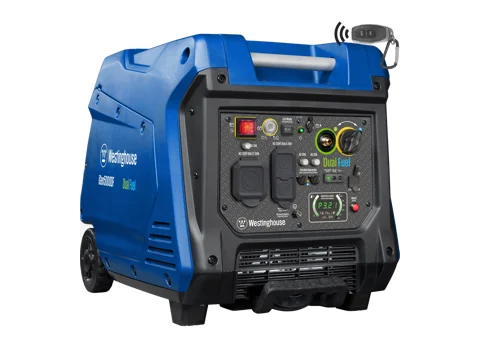
The best all-around generator here. Westinghouse rates it at 5,000 peak watts and 3,900 running watts on gas. It runs on gas or propane, starts with a remote, and is rated as low as 52 dBA. It runs up to 18 hours on 3.4 gallons, has an RV-ready 30-amp outlet, and comes with a 3-year warranty. More than 1,700 ratings average 4.7 stars. At about 105 lb, it’s not light, so plan where it’ll live.
Check Amazon Price: Westinghouse iGen5000DF
Champion 201319
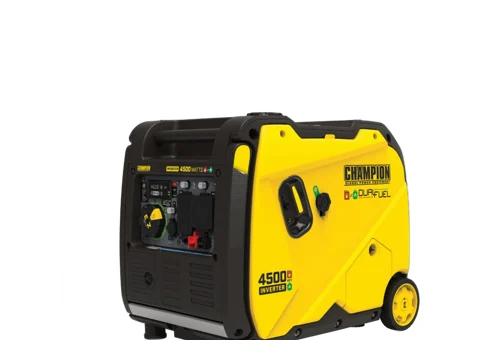
The safety pick. Champion’s CO Shield shuts the engine off if carbon monoxide builds up around it. It’s dual fuel, with 4,500 starting watts and 3,500 running watts on gas, and runs up to 14 hours on gas or 21 hours on propane. It’s parallel ready, so you can link a second one later, and it has a 3-year warranty. At 61 dBA, it’s the loudest generator here.
Check Amazon Price: Champion 201319
WEN 56380i
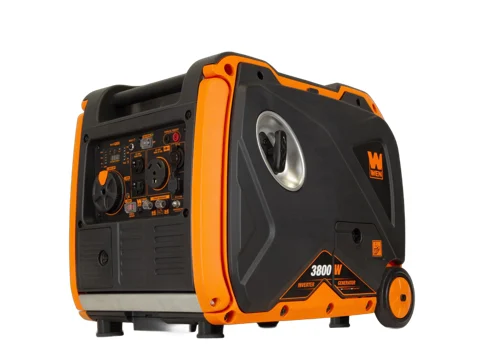
The budget pick. For about $700, you get 3,800 starting watts and 3,400 running watts, electric start and a 30-amp RV outlet. It runs about 8.5 hours at half load on its 2.2-gallon tank. It’s gas only and weighs 99.2 lb. More than 2,400 ratings average 4.7 stars, and it has a 2-year warranty. See all our picks in best inverter generators for home backup.
Check Amazon Price: WEN 56380i
The power stations worth buying
Anker SOLIX C1000 Gen 2
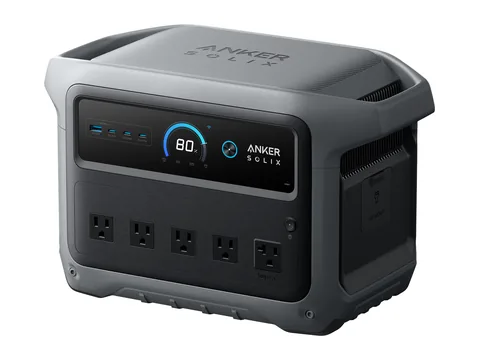
The best value station. It has 1,024 Wh and 2,000 W of output (3,000 W peak), a full recharge in about 49 minutes at 1,600 W, and 600 W of solar input. It switches over in 10 ms when the power cuts out, fast enough to work as a UPS for a router or CPAP. Anker rates the battery for 4,000 cycles to 80%. It weighs 24.9 lb. If you’re looking at its smaller sibling, see our Anker SOLIX C300 review.
Check Amazon Price: Anker SOLIX C1000 Gen 2
EcoFlow DELTA 3
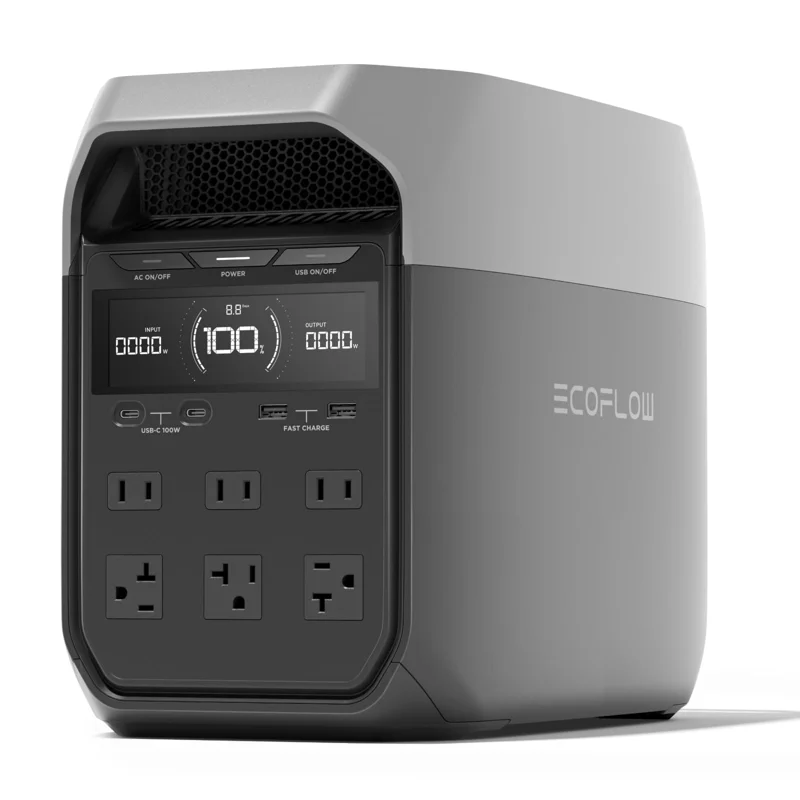
The one that grows with you. It starts at 1,024 Wh and expands to 5 kWh with extra batteries. Output is 1,800 W, with X-Boost up to 2,200 W, and it charges to 80% in about 30 minutes (full in about 56). It takes up to 500 W of solar and runs under 30 dB at 600 W. More than 1,400 ratings average 4.7 stars. It weighs 27.5 lb.
Check Amazon Price: EcoFlow DELTA 3
Jackery Explorer 1000 v2
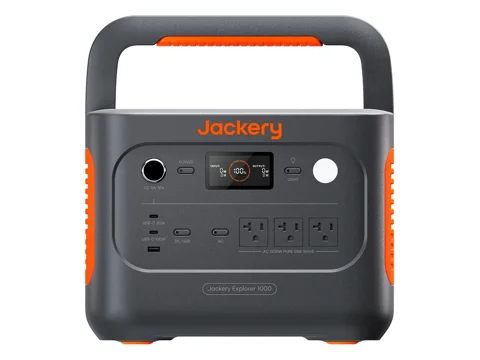
The lightest of the three, at 23.4 lb. It has 1,024 Wh and 1,500 W (3,000 W surge), 10 ms UPS, and a 4,000-cycle battery. Charging takes about 1.25 hours by default, or about 50 minutes with Jackery’s emergency charge mode in the app. Solar works with Jackery’s own panels. More than 3,700 ratings average 4.7 stars, the most of any pick here.
Check Amazon Price: Jackery Explorer 1000 v2
The setup I’d pick
If outages where you live are short, a few hours here and there, a power station alone covers it with no fuel, no fumes and no noise. If they stretch into days, get a generator for the heavy stuff and a power station for the night. Run the generator outside during the day for the furnace and fridge, recharge the station from it, then shut the generator off at night and let the station run the CPAP, router and lights.
For more, see our power outage kit, home backup generators, power stations for a fridge and power stations for a CPAP.
We may earn a commission if you buy through links on this page. It never changes what we recommend. As an Amazon Associate we earn from qualifying purchases. Learn more.